

2026 Food Trends among Gen Z and Younger Millennials
Updated: July, 2026
Published: January, 2025
The food preferences of young consumers are evolving, reflecting broader societal trends and personal priorities. Opeepl Youth Pulse Study among Gen Z and younger millennials sheds light on the key factors shaping their food choices. From sustainability and dietary habits to the growing popularity of plant-based meals and fortified foods, these insights highlight the trends set to influence the food market in 2026. The article explores major food trends among youth across Europe, as revealed by the research.
Unless otherwise noted, data in this article reflects Wave 5 of our Youth Pulse Study (Q1 2026), covering 15–30 year olds. Some sections draw on Wave 3 (Q3 2024), which covered a slightly narrower age group of 15–27 year olds.
38% of Young Consumers Follow a Diet
Research on youth food lifestyles shows that 62% of Gen Z and younger millennials do not follow any specific diet. Meanwhile, 6% follow a dairy-free diet, 6% practice intermittent fasting, 5% are vegetarian, 5% follow a gluten-free diet, 4% are flexitarian, and 4% are vegan. Additionally, 2% of 15-30 y.o. are pescatarian, 3% follow the keto diet and 2% follow the paleo diet.
Food Lifestyles Among Young Consumers (2024-2026 Development)
| Diet / Lifestyle | Wave 3 (Q3 2024) | Wave 4 (Q2 2025) | Wave 5 (Q1 2026) |
|---|---|---|---|
| Do not follow any specific diet | 61% | 61% | 62% |
| Practice intermittent fasting | 5% | 7% | 6% |
| Follow a dairy-free diet | 5% | 6% | 6% |
| Follow a gluten-free diet | 4% | 6% | 5% |
| Are vegetarian | 5% | 6% | 5% |
| Are vegan | 4% | 4% | 4% |
| Are flexitarian | 4% | 4% | 4% |
| Are pescatarian | 2% | 3% | 2% |
| Follow keto | 2% | 3% | 3% |
| Follow paleo | 2% | 2% | 2% |
Source: Opeepl Youth Pulse Study, Waves 3-5 (Q3 2024 – Q1 2026). Q: "Do you follow any specific diet or food lifestyle?"
While females were more likely to follow a diet than males back in 2024 (36% vs. 28%), the gender gap has basically closed in 2026 - 38% of young females and 39% of young males follow a specific food lifestyle. From a country perspective, Germany has the highest percentage of youth following a diet, at 42%, while the UK and Spain have the lowest, at 36%. It is worth mentioning that the number of Gen Z and younger millennials following a diet in the UK grew significantly compared to 27% in 2024 - up by 9 pp.
11 Food Trends to Watch in 2026
To spot relevant trends among Gen Z and younger millennials in the food category, half of respondents were asked an open-ended question: 'What new trend in the food category have you noticed recently that you think will become increasingly important for consumers?’. The open-ended responses were grouped to find patterns or small-but-growing ideas that kept emerging.
The other half of respondents were asked to rank the identified re-emerging trends: ‘Which trend do you think will matter most to people when choosing food products in the future?’
The trends were ranked 1–5, where 1 = Highest Rank, 5 = Lowest Rank.
 1
1
Real Food & Simple Ingredients
Consumers are prioritising overall health and nutrition by choosing “real food” and cooking with simple, minimally processed ingredients while rejecting ultra-processed food.
 2
2
TikTok Food Trends (Dubai Chocolate)
Global “destination” foods go mainstream when social media meets tech-driven amplification, turning niche items into mass cravings, like Dubai chocolate, Korean/Asian foods and tacos.
 3
3
Budget Eating & Value Choices
Rising prices are shaping food behaviour: consumers seek cheaper options, value formats, promotions and “smart swaps” without giving up too much quality.
 4
4
Quick Healthy Meals & Meal Prep
Youth want quick, practical meal solutions (meal prep, ready ideas) that still feel “healthy”, with preferences heavily influenced by recipe culture and creator-led content.
 5
5
Vegan Indulgent Options
Plant-based eating continues to broaden: vegan and vegetarian options are normalised, with more meat substitutes.
 6
6
Local Food & Regional Specialties
Rising preference for locally rooted foods sourced from nearby producers, driven by support for the local economy and perceptions of freshness and quality.
 7
7
Fast Food & Indulgence Culture
Despite the clean eating push, fast food choices, like pizza and burgers, remain highly prevalent, revealing a gap between health aspirations and comfort-driven behaviour.
 8
8
Less Sugar & “Free-From” Choices
Consumers increasingly opt for simpler, “free-from” products, like reduced or zero sugar, gluten-free, and lactose-free, as an easy way to feel healthier.
 9
9
Protein Boosted Snacks & Meals
Protein is emerging as a key nutrition claim in snacks and meals, linked to fitness, satiety, muscle support and performance.
 10
10
Organic & Natural Sourcing
Youth lean on organic and natural cues as a signal of “cleaner, safer” food, expecting brands to back it with ethical sourcing and sustainable practices.
 11
11
Keto, Fasting & Gut-Health Eating
Consumers are embracing structured eating, like keto, intermittent fasting, and gut-focused foods, to boost energy, digestion, weight management and overall wellbeing.
*Ranked 1–5, 1 = Highest Rank, 5 = Lowest Rank. Source: Opeepl Youth Pulse Study, Wave 5 (Q1 2026).
Based on 2,500 interviews with 15–30 year olds. Get the full food trends data. Download the insights report.

Brick-and-Mortar Dominates Young Consumers’ Grocery Shopping
62% of young consumers buy their food exclusively in physical stores, while 3% percent do so exclusively online. 36% use a combination of both channels. Across EU5 countries, online grocery shopping is most popular among British youth, with 4% shopping exclusively online and 49% combining online and offline methods. Meanwhile, brick-and-mortar dominates among Italian young consumers, with 72% shopping solely in physical stores (Opeepl Youth Pulse Study Wave 3, Q3 2024).
Taste and Price Are the Main Factors Influencing Youth Food Choices
Taste (60%) and price (57%) are the main factors influencing youth food choices. Meanwhile, 32% buy food based on nutritional content (e.g., low sugar/calories, vitamins, protein), 26% prioritise local produce, another 26% seek organic or natural ingredients, and 21% choose food based on recommendations from friends or family (Opeepl Youth Pulse Study Wave 3, Q3 2024).
Young Shoppers Are Primarily Worried about Sugar and Calories
When choosing food, 33% of youth cite sugar content as their primary health concern, while 31% are focused on calorie count. Other key concerns include fat content (29%), artificial ingredients and preservatives (22%), protein content (20%), GMOs (14%), and the sustainability of ingredients (14%). Additionally, 12% are concerned about organic ingredients, 11% about sodium/salt levels, and 22% admit they do not care about any of these factors. From a gender perspective, females are significantly more concerned about artificial ingredients and preservatives than males (26% vs. 17%). Conversely, males show greater concern for protein content in food, with 24% compared to 16% of females (Opeepl Youth Pulse Study Wave 3, Q3 2024).
Added Vitamins Are the Top Wish for Fortified Foods
37% of young consumers say they would like to see more food options with added vitamins, and 26% would like more options with added minerals. Other desired fortified foods include those with added fibre (20%), omega-3 fatty acids (17%), antioxidants (12%), probiotics (12%), and collagen (11%). Females show greater interest in fortified foods with added vitamins, minerals, antioxidants, probiotics, and collagen, whereas males are more interested in foods with added fibre compared to females. Both genders show equal interest in foods enriched with omega-3 fatty acids. (Opeepl Youth Pulse Study Wave 3, Q3 2024).
Plant-Based Meals Popular among Non-Vegans and Non-Vegetarians
Plant-based meals are popular among non-vegetarian and non-vegan consumers as well. In fact, 48% of Gen Z and younger millennials who don’t identify as vegetarian or vegan have at least one plant-based meal per week.
Popularity Of Plant-Based Meals Among Non-Vegetarian And Non-Vegan Young Consumers
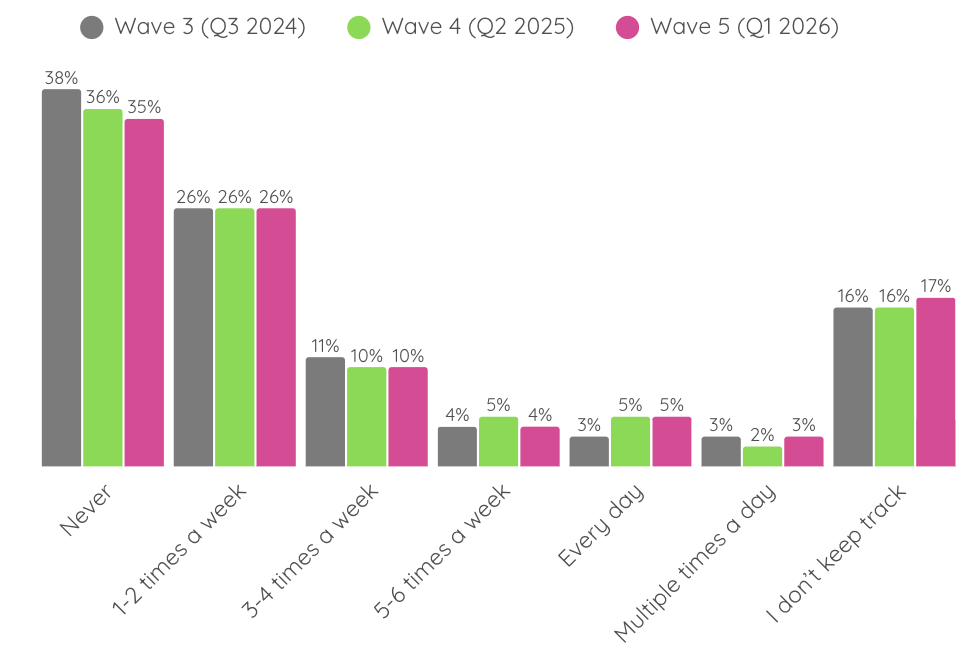
Graph: Opeepl Youth Pulse Study, Waves 3-5 (Q3 2024 - Q1 2026)
Females are more likely to eat plant-based meals than males—69% of females who don't identify as vegetarian or vegan still eat plant-based meals, compared to 61% of males. However, the gender gap appears to be closing: it narrowed by 5 percentage points compared to 2024, when 68% of females and 55% of males who didn't identify as vegetarian or vegan ate plant-based meals. Among the EU5, eating plant-based meals is most popular in Germany and least popular in Spain: 58% of German youth eat vegan or vegetarian meals at least weekly, compared to 44% in Spain.
4 out of 10 Dinners Are Not Cooked at Home
Saturday is the most popular day for young consumers to dine out or order takeaway, while Friday is the day when European youth are most likely to eat prepared or ready-to-eat foods, such as frozen pizza. Mondays and Tuesdays are 'cooking-at-home' days, with 74% of young consumers preparing meals on those days. On average, 40% of youth dinners are not cooked at home. Saturday is the most popular day to dine out across all EU5 countries, particularly among Italian and Spanish youth. More than half of Italian youth and 47% of Spanish youth dine out on Saturdays (Opeepl Youth Pulse Study Wave 3, Q3 2024).
Young Consumers’ Dinner Choices During A Typical Week
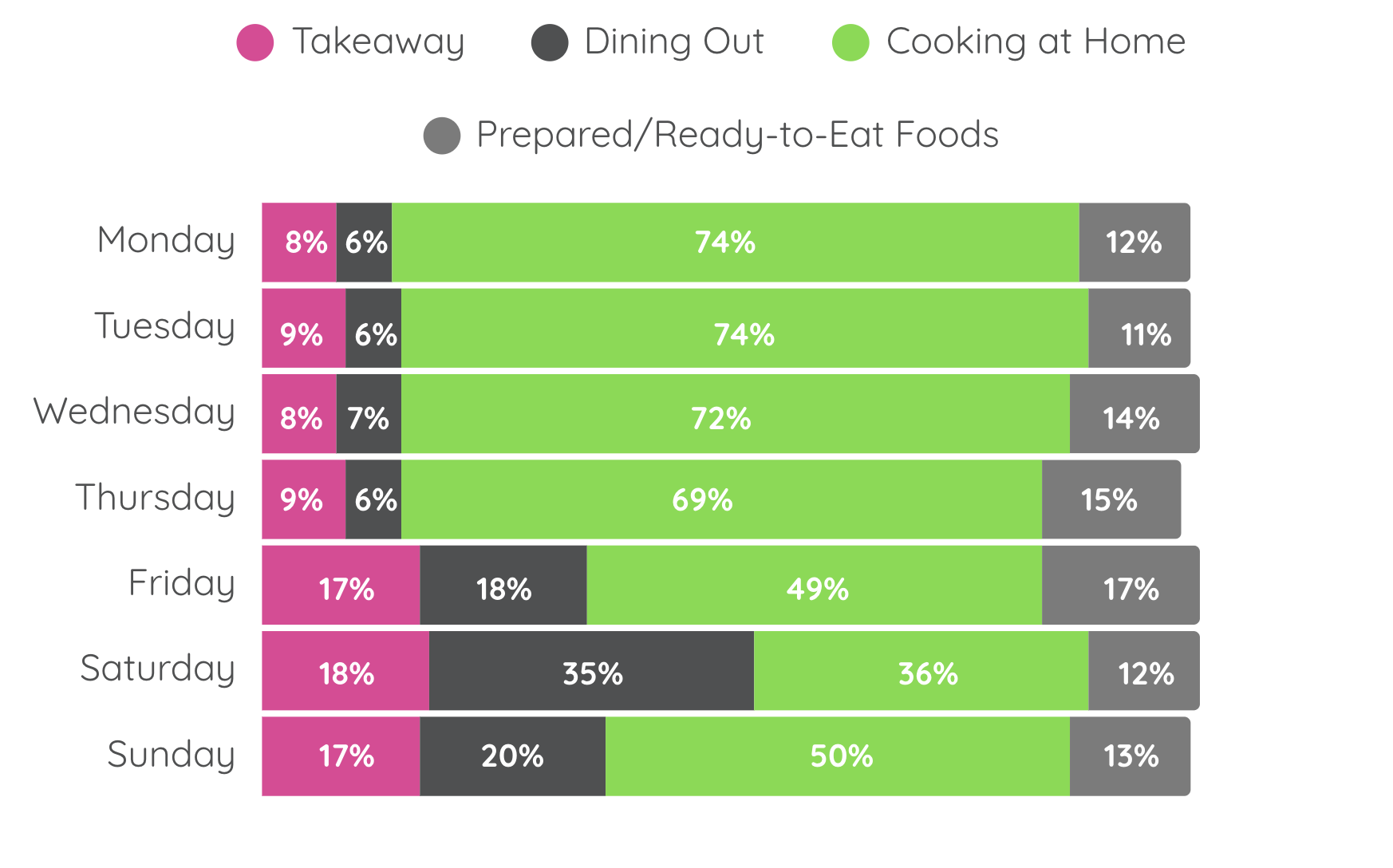
Graph: Opeepl Youth Pulse Study, Wave 3 (Q3 2024)
Young Consumers Are Willing to Pay More for Sustainable Food
Sustainability is an important factor in food choices for 40% of young consumers. Among the EU5 countries, it matters most to Italian youth (58%) and least to those in France (36%). Additionally, 70% are willing to pay more for sustainable food, with an average willingness to pay up to 10% extra. Youth in France and the UK are the least likely to pay more for sustainable options (67%), while German youth are the most willing, with 76% expressing a willingness to pay extra (Opeepl Youth Pulse Study Wave 3, Q3 2024).
Final Thoughts: What This Means for Brands
In 2026, the food market will undoubtedly be shaped by the values and habits of today’s youth. Sustainability, health consciousness, and convenience are driving forces, with notable regional and gender differences. The willingness of Gen Z and younger millennials to embrace plant-based meals, pay more for sustainable food, and explore fortified options demonstrates their openness to change and innovation. Understanding these trends is essential for brands in the food industry aiming to meet the needs and expectations of the next generation.

Discover more trends among 15-30 y.o. in Youth Pulse Report
Opeepl Youth Pulse is a bi-annual study that keeps pulse on the latest developments in the youth market. Discover key youth trends in consumer confidence, media habits, attitudes, values, and four major categories: Food, Beverages, Fashion, and Personal Care.