

Consumer Confidence among Gen Z and Younger Millennials: Main Developments from 2023 to 2026
Updated: July, 2026
Published: June, 2024
Gen Z and younger millennials' financial confidence hasn't followed a straight line. Since Opeepl began tracking young people across the UK, Germany, France, Italy and Spain in October 2023, their financial outlook has climbed, dropped, recovered, and cooled again. Five waves of data later, the honest picture for brands isn't "confidence is rising" — it's that young consumers' mood is genuinely sensitive to the economic moment, and reading the latest wave in isolation can be misleading. This article pulls together five waves of Opeepl's Youth Pulse study, from Wave 1 (Q4 2023) to Wave 5 (Q1 2026), to show how that mood has moved, who it moves for, and where it actually shows up in spending.
Data in this article reflects data from Waves 1–5 of the Opeepl Youth Pulse Study (Q4 2023 to Q1 2026). Waves 1–3 covered 15–27 year olds, and from Wave 4 onwards the respondent base was expanded to 15–30 year olds.
How Young Consumers' Financial Outlook Has Evolved Since 2023
Opeepl Youth Pulse study measures two things every wave: how Gen Z and younger millennials expect their financial situation to change over the next six months, and how they expect their spending to change over the same period. Both are net indices (the share with a positive outlook minus the share with a negative one), so a higher number means more optimism.
Wave 2 (Q2 2024) looked like the start of a genuine upswing, with both indices up 6 percentage points (pp) from Wave 1. But Wave 3 (Q3 2024) reversed that gain almost entirely: financial outlook fell 4pp and spending expectations dropped 7pp, wiping out the earlier "rise" narrative. Wave 4 (Q2 2025) brought a rebound, with spending expectations climbing 9pp to their highest point in the series. Wave 5 (Q1 2026), the most recent wave, shows a slight cooling again: financial outlook is essentially flat (-1pp) and spending expectations are down 3pp.
Consumer Confidence Index among Gen Z and Younger Millennials (2023-2026 Developments)
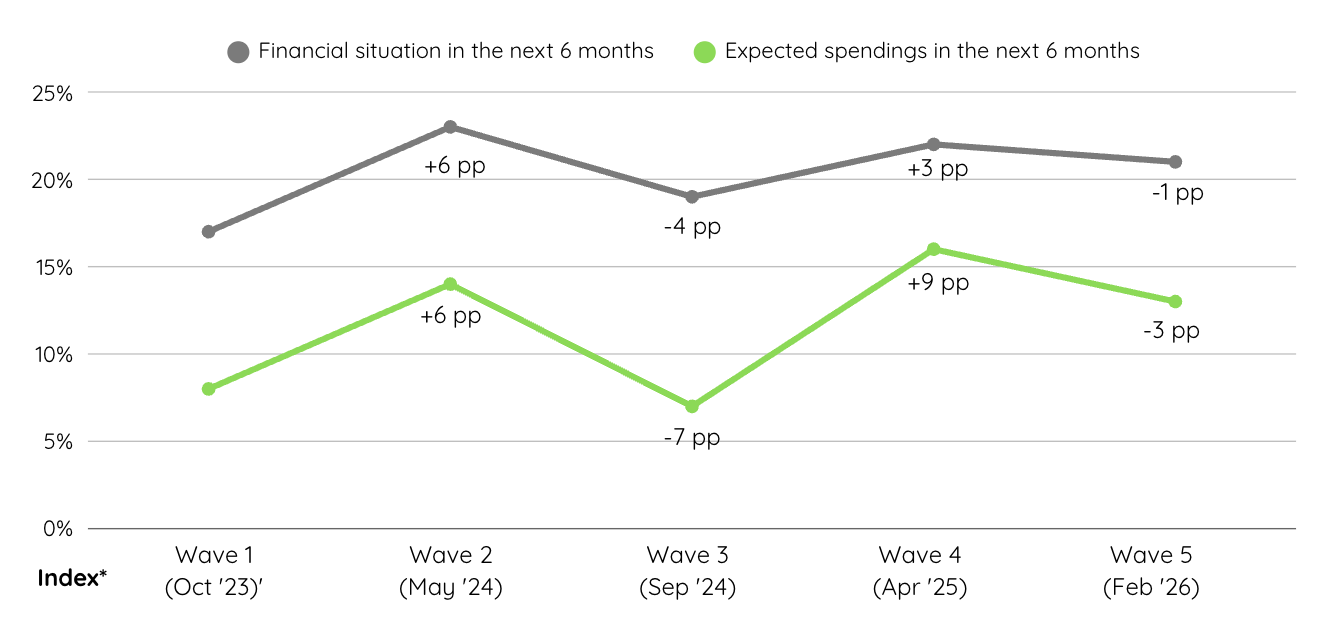
Source: Opeepl Youth Pulse Study, Wave 5 (Q1 2026). *Index = Pct. Positive Outlook - Pct. Negative Outlook
Wave 5 headline figures: 35% of 15–30 year olds expect their financial situation to improve, 32% expect to increase their spending in the next 6 months, and 42% expect to keep spending at the same level.
Discover more insights on consumer confidence among 15-30 y.o. in our latest Youth Pulse Report
Confidence Splits By Gender
The overall trend hides a gender gap that's been fairly consistent since Wave 1 (Q4 2023): young women's financial outlook and spending expectations have swung more sharply in both directions than young men's. In Wave 3 (Q3 2024), when overall confidence dropped, women's spending expectations fell 7pp compared with a 6pp fall for men. In Wave 4's (Q2 2025) recovery, women's spending expectations rose 8pp versus a 9pp rise for men, but Wave 5 (Q1 2026) shows the genders diverging: women's financial outlook actually ticked up slightly (+2pp) while men's fell (-4pp), even though both groups pulled back on spending expectations.
Consumer Confidence Index among Gen Z and Younger Millennials: Gender Split
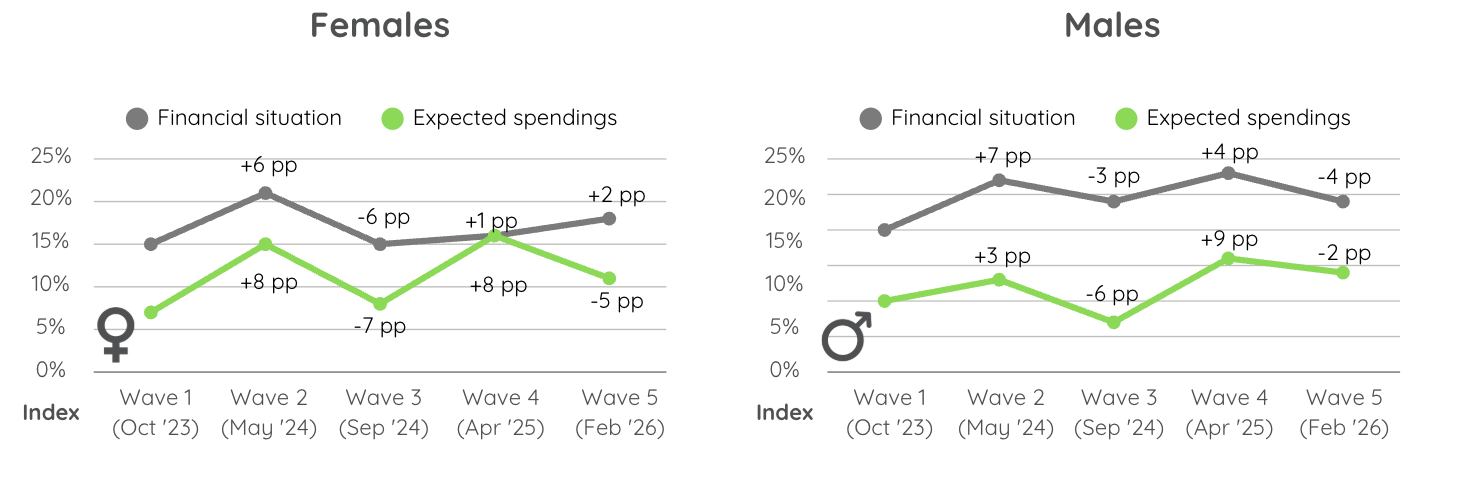
Source: Opeepl Youth Pulse Study, Wave 5 (Q1 2026)
Country Perspectives: Who's Feeling Confident In 2026
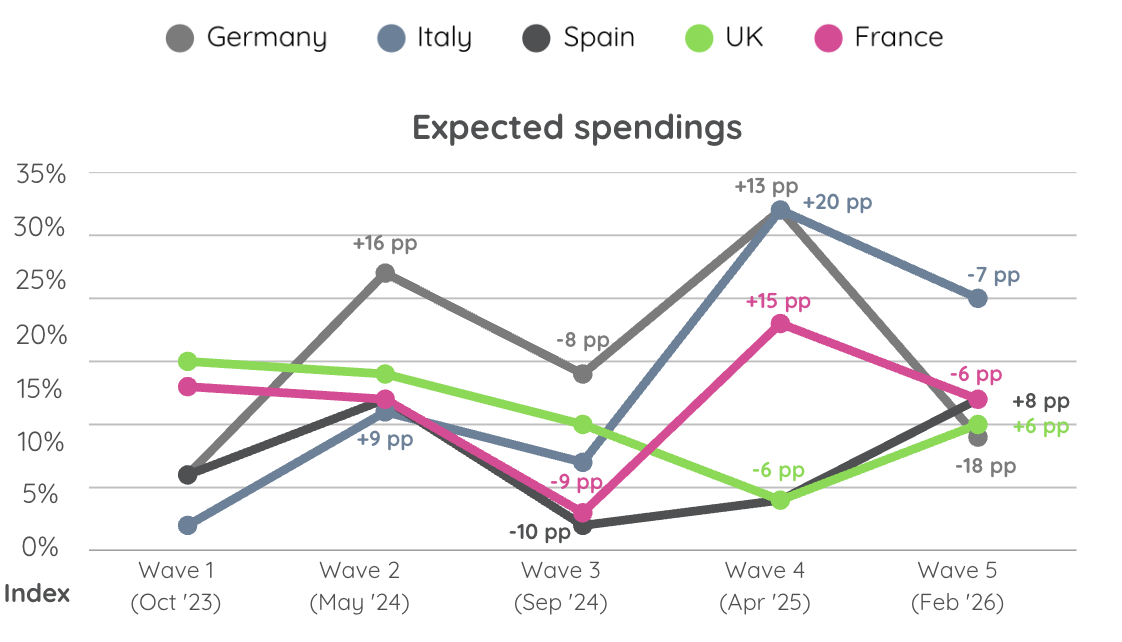
Country-level results show the EU5 is no longer moving in sync. In Wave 5 (Q1 2026), Italian and Spanish 15-30 y.o. report a stable financial situation, while British, German and French consumers are slightly more negative than in Wave 4 (Q2 2025). Spending intentions have split sharply by country: Germany posted the single largest movement in the whole dataset, an 18pp drop in expected spending since Wave 4 (Q2 2025), while UK and Spain are the only two markets where Gen Z and younger millennials expect to increase their spending.
This isn't a new pattern. Germany led EU5 optimism in Waves 1–2 (Q4 2023 - Q2 2024), partly attributed to rising salaries and falling inflation. Italy has repeatedly shown a mismatch between a middling financial outlook and strong spending intentions — including the largest spending increase of any country in Wave 4 (Q2 2025) - up by 20pp. The UK, by contrast, has been the most consistently cautious spender of the five markets, which might be linked to lingering Brexit-related uncertainty.
Young Consumers Financial Outlook across EU5 Countries (2023-2026 Developments)
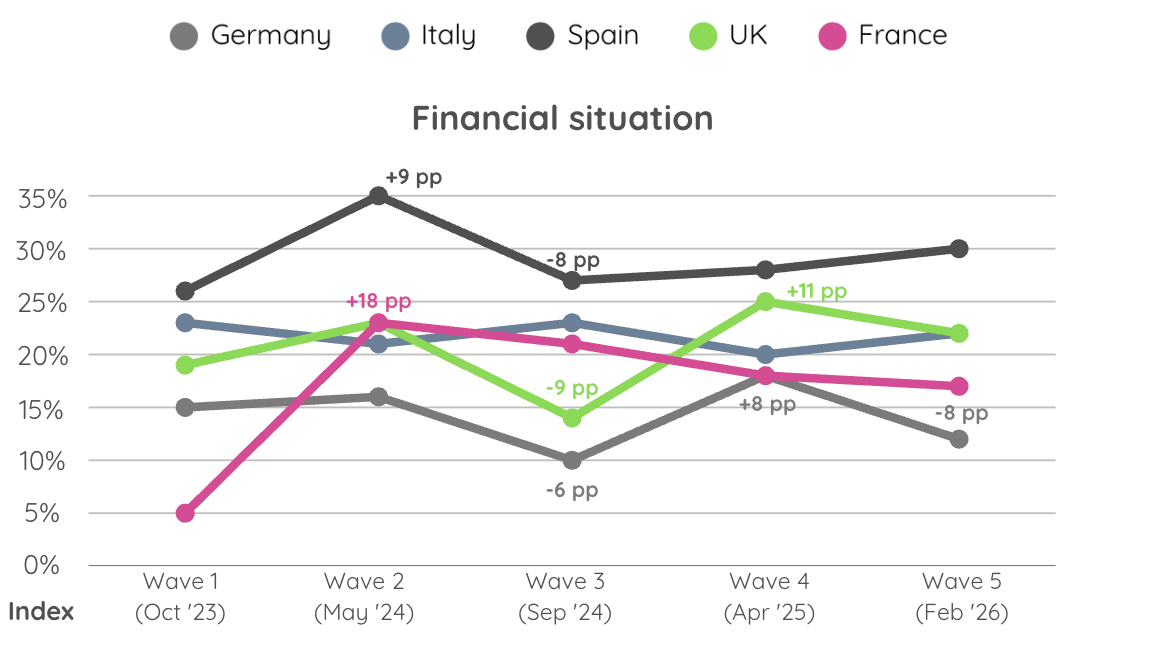
Source: Opeepl Youth Pulse Study, Wave 5 (Q1 2026)
What This Means For Brands
The headline takeaway isn't that Gen Z and younger millennials’ confidence is rising or falling — it's that it moves, and it moves differently by market and gender. Brands treating any single wave of data as the definitive story risk over- or under-reacting. A few practical implications:
Don't anchor campaigns to a single wave. The swing from Wave 2's (Q2 2024) optimism to Wave 3's (Q3 2024) pullback happened in four months. Plan spending-sensitive campaigns (fashion, personal care, alcoholic beverages) with the expectation that young people’s sentiment can reverse within a single fieldwork cycle.
Localise, don't average. An EU5-wide "young consumers are cautious" or "young consumers are confident" message will be wrong somewhere. Germany's 18pp spending pullback and the UK/Spain uptick are happening at the same time, in the same wave. This isn't new: Germany led EU5 optimism in Waves 1–2 (Q4 2023 - Q2 2024), Italy has repeatedly shown strong spending intent despite a middling financial outlook, and the UK has been the most consistently cautious spender of the five markets.
Watch the outlook/spending gap, not just the headline number. When the financial situation index and the spending index move apart — as in Wave 5 (Q1 2026), where outlook held roughly steady but spending intentions fell — it can signal caution that isn't yet showing up in how young people describe their finances, but is already showing up in their spending plans. The Wave 1 (Q4 2023) data shows this gap can run the other way too: most young people said saving was the sensible thing to do, yet most still planned to spend the same or more.
Segment by gender where the message is spending-sensitive. Young women's financial outlook and spending expectations have swung more sharply in both directions than young men's, and in Wave 5 (Q1 2026) the two genders even moved in opposite directions on outlook. A single segment can obscure a meaningfully different trajectory for men and women in the same market and wave.

Discover more trends among 15-30 y.o. in Youth Pulse Report
Opeepl Youth Pulse is a bi-annual study that keeps pulse on the latest developments in the youth market. Discover key youth trends in consumer confidence, media habits, attitudes, values, and four major categories: Food, Beverages, Fashion, and Personal Care.