

The Shift in Young Consumers’ Alcohol Consumption: Trends & Insights
Updated: July, 2026
Published: May, 2025
Is Gen Z and younger millennials turning away from alcohol?
The picture is more nuanced than a simple yes or no. Opeepl’s Youth Pulse study shows a generation of young people who haven't abandoned alcohol, but who drink less often, more intentionally, and with a growing appetite for alcohol-free alternatives.
Let's dive into the real numbers and behaviours hidden behind young consumers' evolving relationship with alcohol.
Unless otherwise noted, data in this article reflects Wave 5 and Wave 4 (Q2 2025), covering 15–30 year olds. Some sections draw on Wave 3 (Q3 2024), which covered a slightly narrower age group of 15–27 year olds. All the respondents was asked whether they consume alcohol, but only respondents over 18 years old were asked further questions about this category.
48% of Young Consumers Are Skipping Alcohol Entirely
Forget the stereotype of Gen Z and younger millennials chasing shots and hangovers. Today's young consumers aren't ditching alcohol completely, but they are drinking on their own terms.
Q3 2024: Only 50% of young consumers say they drink alcohol at all — 45% of young females and 55% of young males.
Q2 2025: 52% of respondents say they currently consume alcohol — 47% of young females and 56% of young males, each up slightly.
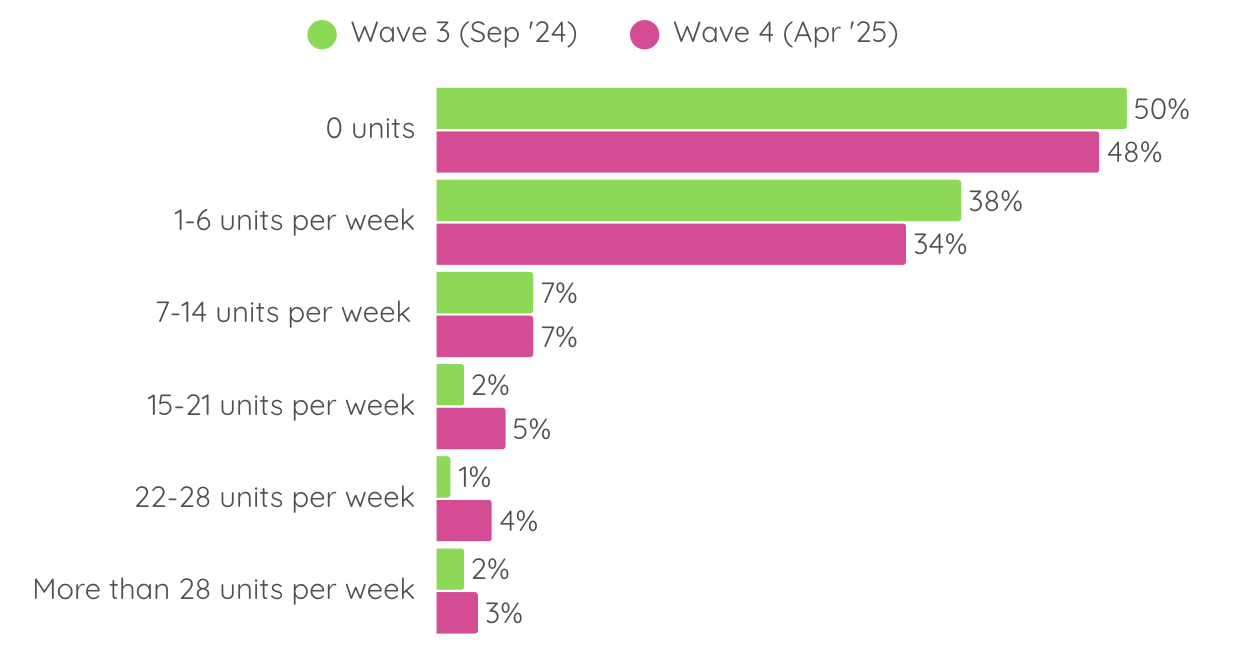
Young Consumers’ Weekly Alcohol Consumption in Units
Source: Opeepl Youth Pulse Study, Wave 4 (Q2 2025)
48% of respondents drink zero units in a typical week and a further 34% keep it to 1–6 units, so more than eight in ten drink lightly or not at all. The heavier bands remain small — 5% at 15–21 units, 4% at 22–28, and 3% above 28 units — but each has edged up slightly between Q3 2024 and Q2 2025, pointing to a marginally larger tail of heavy weekly consumption.
10 Rising Alcoholic Beverages Trends among Youth
To spot relevant trends among Gen Z and younger millennials in the alcoholic beverages category, half of the respondents in the study were asked an open-ended question: 'What new trend in the alcoholic beverages category have you noticed recently that you think will become increasingly important for consumers?’. The open-ended responses were grouped to find patterns or small-but-growing ideas that kept emerging.
The other half of respondents were asked to rank the identified re-emerging trends: ‘Which trend do you think will matter most to people when choosing alcoholic beverages in the future?’
The trends were ranked 1–5, where 1 = Highest Rank, 5 = Lowest Rank.

Ready-to-Drink (RTDs) are exploding in popularity — especially among young consumers looking for convenience without sacrificing taste and quality.

While flavoured vodka had a reputation for being overly sweet in the past, new variants — featuring bold, nostalgic or spicy flavours — are appealing to a new generation.

Sour beers, mixed fermentation styles, and wild yeast strains are gaining traction. It's about the adventurous experience and the curiosity around how these beers are made.

A new wave of wine coolers and spritzes is hitting the market, bridging the gap between wine and cocktails with a lower ABV. Ideal for socialising in warm weather.

Tea-based alcohol offers a sense of refreshment and often feels less intense than beer or spirits and can be perceived as more natural or health-conscious among youth.

Alcohol and coffee are a favourite pairing among today's youth. Espresso martinis and cold brew liqueurs combine these two beloved beverages into one indulgent experience.

Young drinkers are drawn to mixers and infusions where fruit is the star — especially when it feels real and recognisable. It's about flavour intensity without artificiality.

Younger consumers view innovative, alternative fruit wines as exotic, sustainable, and great conversation starters. They often come from local makers and have a handmade feel.

This is an emerging niche with high potential among foodie audiences. Think Bloody Marys reimagined with smoked tomatoes or gin washed with seaweed.

Botanicals now go beyond gin — herbs, roots, flowers, and spices are appearing in liqueurs, vermouths, and aperitifs. They align with the growing interest in "clean label" products.
*Ranked 1–5, 1 = Highest Rank, 5 = Lowest Rank. Source: Opeepl Youth Pulse Study, Wave 4 (Q2 2025).
Purchase Points and Drivers: How Young Consumers Buy Alcohol
Knowing where Gen Z and younger millennials buy alcohol, and what actually gets them to pick one bottle over another, matters more for brands than the topline consumption numbers.
On channel: a massive 79% of 15-30 y.o. buy their alcohol in physical stores, while only 3% shop exclusively online. In-store still dominates almost everywhere, but that's not universal – online buying varies a lot by market: in Germany, 34% of young consumers do so, while in Spain, only 14% of young consumers choose this option (Opeepl Youth Pulse Study Wave 3, Q3 2024).
On what drives the purchase itself, young people keep it simple: if it tastes good and doesn't break the bank, it's in the cart. Brand name and origin matter far less than the basics.
63% say taste is the top deciding factor
49% care about price
29% look at alcohol content (ABV or strength)
19% consider brand reputation
13% actively choose locally produced options
13% look for convenience (e.g. single-serve, easy-to-open formats)
Taken together, this suggests brand loyalty is fragile in this category: with taste and price this dominant and brand reputation this far down the list, it's flavour innovation and competitive pricing that will move young consumers' actual purchase decisions.
Moreover 17% of Gen Z and younger millennials say sustainability is an important factor when choosing alcoholic drinks — they care how products are made, packaged, and sourced. But when it comes to paying extra for that eco-friendly label, only 53% (of 17%) are willing to spend more, and most cap that premium at around 6% on average (Opeepl Youth Pulse Study Wave 3, Q3 2024).
The takeaway for brands: Gen Z and younger millennials want greener options built into the baseline, not sold as a premium add-on.
Discover more beverage trends among 15-30 y.o. in our latest Youth Pulse Report
Beer Is the Top Alcoholic Beverage among 18-30 Year Olds
Beer comes first, cocktails follow close behind, and preferences shift depending on who you ask.
Most Popular Alcoholic Beverages among Gen Z and Younger Millennials
| Beverage | DrinkersAt least monthly | Weekly DrinkersAt least once a week |
|---|---|---|
| Beer | 70% | 48% |
| Cocktails | 57% | 25% |
| Spirits / Liquors | 50% | 24% |
| Wine | 49% | 23% |
| Champagne / Sparkling Wine | 30% | 13% |
| Cider | 24% | 12% |
| Hard Seltzers | 21% | 12% |
Source: Opeepl Youth Pulse Study, Wave 3 (Q3 2024). Q: "How often do you consume the following beverages?" Gender split: 80% of males drink beer at least monthly, vs. 63% of females who prefer cocktails.
The chart compares two things for each beverage: the share who drink it at all ("Drinkers") versus the share who drink it at least once a week ("Weekly drinkers"). Beer leads on both counts — 70% drink it at least monthly and 48% drink it weekly. Cocktails are a close second on overall reach (57%), but far fewer people drink them weekly (25%), suggesting cocktails are more of an occasional drink than an everyday habit. That pattern holds for spirits, wine, and champagne too: strong overall reach, but the weekly number roughly halves each time. Cider and hard seltzers sit at the bottom of both columns.
Looking at the gender split, 80% of males drink beer at least monthly, while 63% of females say they prefer cocktails over other drinks (Opeepl Youth Pulse Study Wave 3, Q3 2024).
The Rise of Alcohol-Free Drinking
The Youth Pulse study tracks how often young consumers actually reach for alcohol-free drinks. When comparing the Wave 5 (Q1 2026) numbers against Wave 4 (Q2 2025), we see that the shift in a single year is striking.
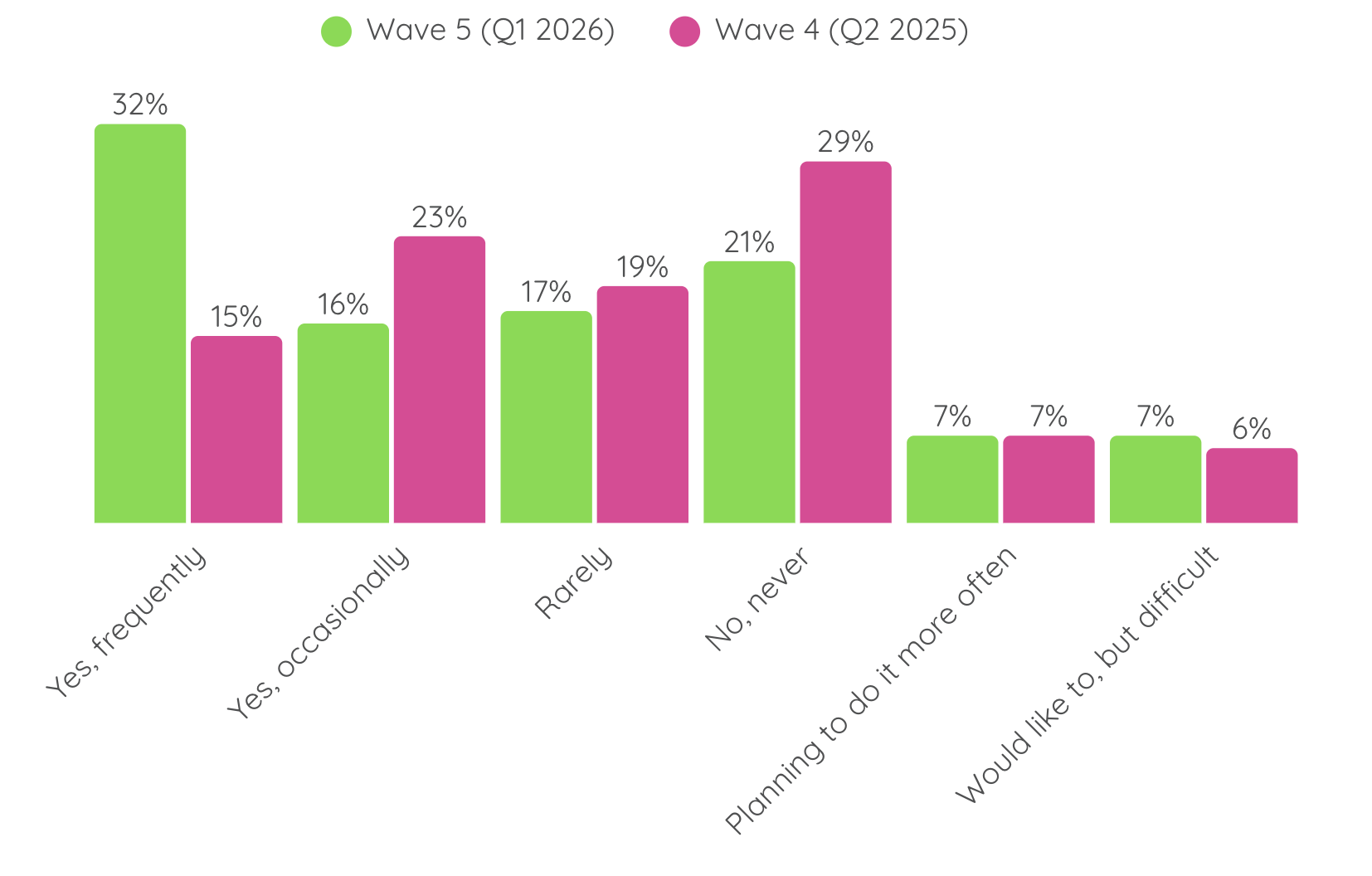
Do you ever choose non-alcoholic versions of alcoholic beverages?
Source: Opeepl Youth Pulse Study, Wave 4 (Q2 2025) and Wave 5 (Q1 2026)
The share of 18-30-year-olds who choose alcohol-free drinks "frequently" more than doubled from 15% to 32%, while the "never" group shrank from 29% to 21%. In other words, alcohol-free isn't just something young consumers are willing to try anymore — for a growing share it's becoming a regular, default choice.
This "sober curiosity" reflects more than health awareness — it's about control, social confidence, and inclusion. Many young people enjoy alcohol-free drinks because they can still socialise, stay clear-headed, and feel part of the moment.
There are several distinct reasons behind the shift to non-alcoholic options:
34% cite health and lifestyle (cutting calories, training, staying sober)
29% choose them for social situations, like being a designated driver or attending work events
23% try them out of curiosity
21% simply prefer the taste
19% point to temporary reasons like medication or fitness goals
9% cite influence from friends or social media
8% cite religious or cultural reasons
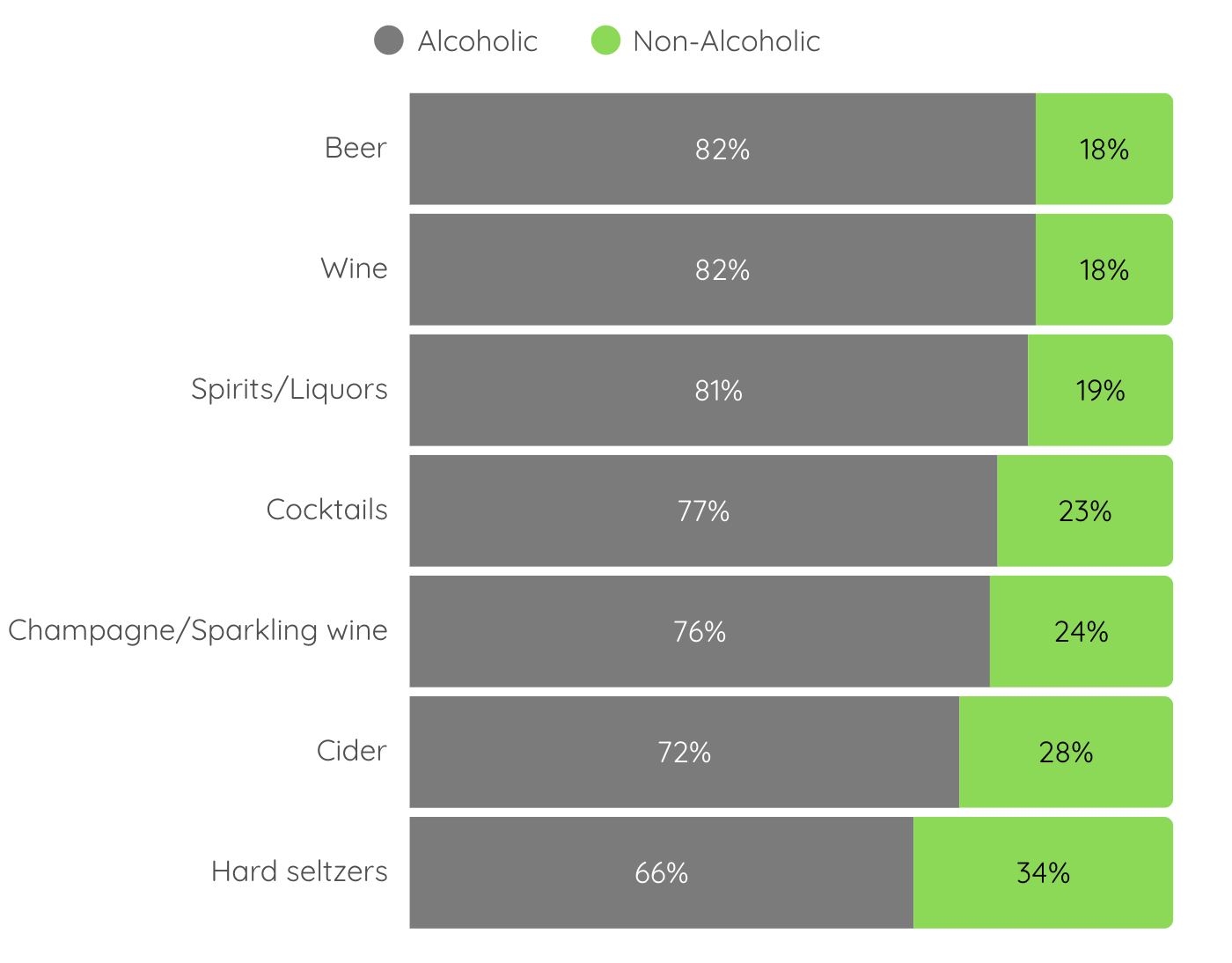
Two categories lead the alcohol-free movement: 28% of Gen Z and younger millennials drink non-alcoholic cider, and 34% drink non-alcoholic hard seltzers — the highest shares among all alcohol-free versions (Opeepl Youth Pulse Study Wave 3, Q3 2024).
How Youth Beverage Consumption Distributes among Alcoholic vs. Non-Alcoholic Versions
Source: Opeepl Youth Pulse Study, Wave 3 (Q3 2024). Q:’You said you drink [beverage]. How is your consumption of it distributed between alcoholic and non-alcoholic versions?’
What This Means for Brands
Gen Z and younger millennials aren't abandoning alcohol: they're approaching it differently. They drink less often, choose based on taste and lifestyle fit, and explore alcohol-free options without hesitation. Whether it's beer, cocktails, canned pre-mixed drinks, or non-alcoholic seltzers, their choices reflect intentionality, balance, and values.
For alcohol brands, understanding their behaviour isn't optional – it's essential. Brands need to offer more than a product: choice, authenticity, and relevance. Don't just sell a drink – sell meaning. Make non-alcoholic options more visible, more accessible, and more part of the default. The easier the switch feels, socially and emotionally, the more young people will make it.

Discover more trends among 15-30 y.o. in Youth Pulse Report
Opeepl Youth Pulse is a bi-annual study that keeps pulse on the latest developments in the youth market. Discover key youth trends in consumer confidence, media habits, attitudes, values, and four major categories: Food, Beverages, Fashion, and Personal Care.