

Updated: September, 2026
Published: April, 2024
The 5 Key Benefits of Market Segmentation for Brands
Most brands believe they know their customers. Then they look at the average — and the average, it turns out, describes almost no one. Market segmentation is how brands move past the mythical “typical customer” to the real, distinct groups hiding inside a market. This article covers what segmentation is, the five benefits that make it worth the effort, the main ways to do it, and a single figure from our own research that shows just how much one market average can conceal.
What Market Segmentation Means
Market segmentation is the practice of dividing a broad market into smaller groups of people who share meaningful characteristics — needs, attitudes, behaviours or circumstances — so a brand can serve each group more precisely than a one-size-fits-all approach ever could.
Done well, it replaces guesswork about a single “average” audience with a clear map of who your customers actually are and what each group wants. That map then informs everything downstream: product, messaging, channel choice and budget. It is closely related to consumer segmentation, which applies the same logic to an individual brand’s own customer base.
In practice, that means taking a single, undifferentiated market — where everyone is treated as a version of the same “average” customer — and resolving it into a handful of groups distinct enough to act on:
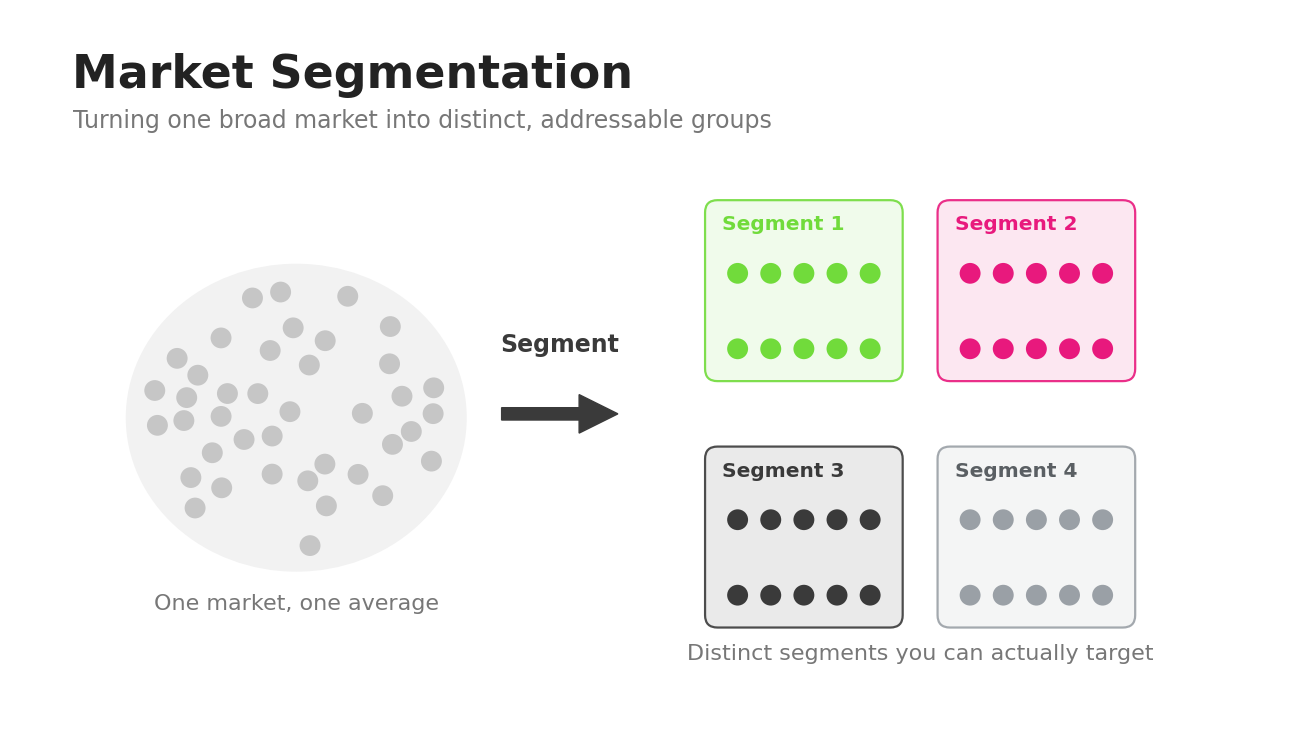
Each segment shares enough in common — in needs, attitudes or behaviour — to justify its own message, product emphasis or channel mix. The goal isn’t more groups but more distinct ones: a segmentation only earns its keep when the groups differ enough that treating them separately changes what you would do.
The Five Key Benefits Of Market Segmentation
The case for segmentation comes down to five compounding advantages.
1. Sharper Targeting
Generic outreach spreads a message thinly across everyone and lands with no one. Segmentation lets a brand identify the groups it most wants to reach and speak to their specific motivations, rather than broadcasting a lowest-common-denominator message. The stakes are highest when a brand enters unfamiliar territory: when the skincare brand Rudolph Care prepared to expand into two new markets, it used a consumer segmentation study to work out which groups to prioritise in each — rather than launching against an undifferentiated “average” shopper and hoping for the best.
2. Deeper Customer Understanding
Every organisation assumes it understands its customers. Segmentation tests that assumption by pulling a broad audience apart to reveal the differing needs and preferences inside it — differences a headline average quietly hides. Those insights let a brand tailor its offer to what customers want but have not necessarily articulated. (The section below shows how large that hidden variation can be.)
3. More Efficient Marketing Spend
When budgets are tight, reach for its own sake is a liability. By concentrating on the groups most likely to respond, segmentation cuts spend wasted on audiences that were never going to convert, and points investment towards the products, features and channels a target group genuinely values. The same insight trims cost on the things they do not.
4. Stronger Engagement And Loyalty
Relevance earns retention. When promotions, recommendations and messaging are built around a group’s real preferences, customers feel understood rather than marketed at — and that feeling sustains loyalty over time. Netflix’s taste-based recommendations are a familiar case: the more the experience reflects a viewer’s preferences, the longer they stay.
5. Durable Competitive Advantage
In a crowded market, the brands that win are the ones that serve specific, underserved groups better than a generalist competitor can be bothered to. Segmentation also acts as an early-warning system: because a brand is watching defined groups rather than the mass market, it spots shifts in behaviour and preference sooner and can adapt while rivals are still reading the average.
Segmentation In Practice: Why The Average Misleads
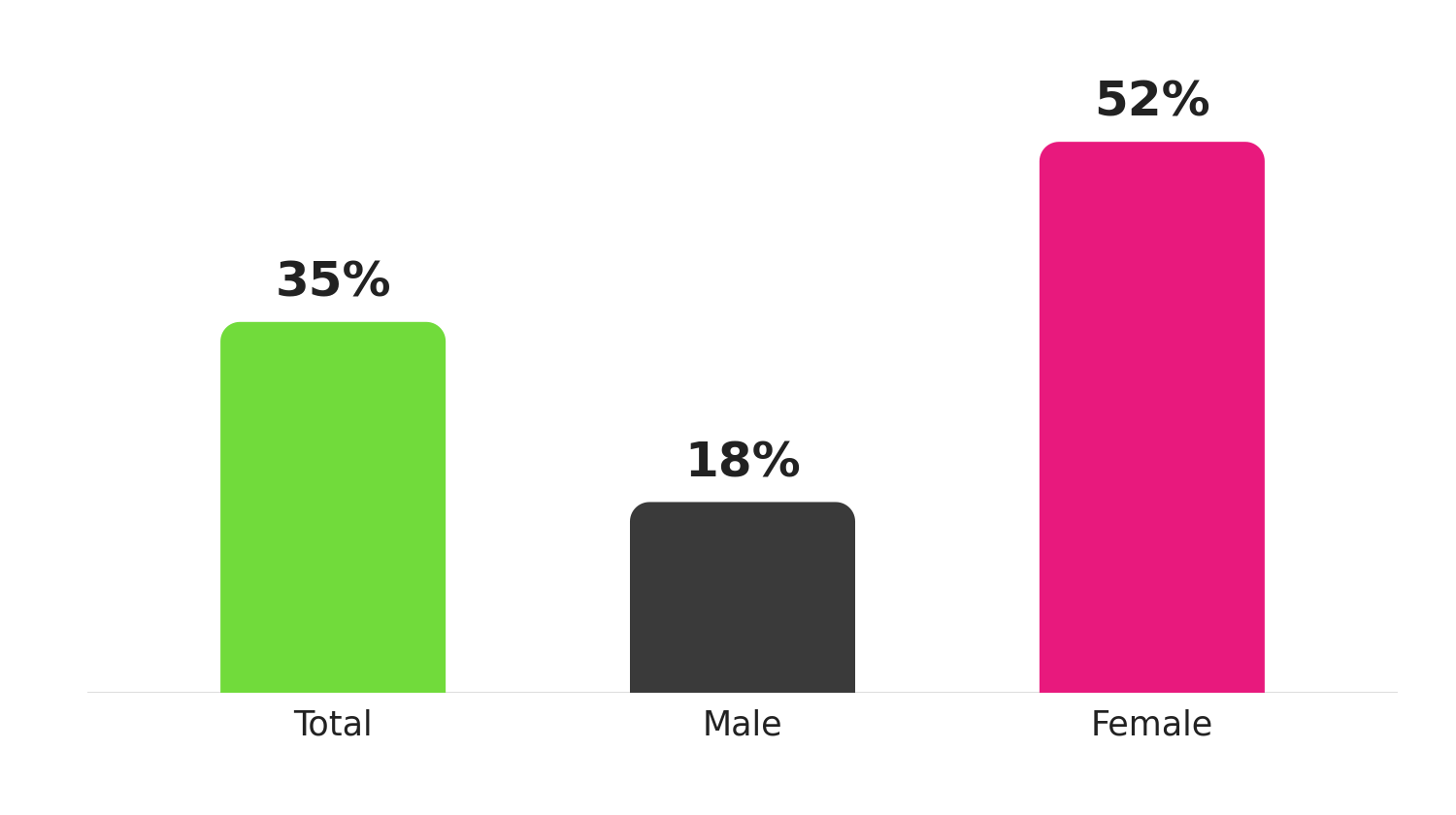
Here is the case for segmentation in a single figure. In our Youth Pulse study, Wave 5, across 15–30-year-olds in five European markets, 35% said they had used Pinterest recently. Taken at face value, that number tells a brand roughly a third of the youth market is reachable there — a modest, general-interest channel worth a modest, general budget.
Pinterest Use Among 15–30 y.o., by Gender
Source: Opeepl Youth Pulse Study, Wave 5 (Q1 2026)
Segment the same respondents by gender, and that reading falls apart: 52% of women reported using Pinterest, against just 18% of men. The 35% average sits in a gap where almost no one actually falls. A brand planning around “a third of young people” would under-invest against a highly engaged female audience and over-invest against a largely absent male one — and never understand why the campaign underperformed. That is the entire argument for segmentation, in one chart.
See segmentation applied to your market

Opeepl's consumer segmentation studies map the real groups inside your audience — their attitudes, preferences and behaviour — so you can plan around the differences that matter, not a misleading average.
The Main Types Of Market Segmentation
Most segmentation strategies draw on one or more of the following approaches:
Demographic — age, gender, income, education, life stage. The most common starting point, and the basis of the example above.
Geographic — country, region, urban versus rural, climate. Useful wherever location shapes need or availability.
Psychographic — values, attitudes, interests and lifestyle. Explains why people choose, not just who they are.
Behavioural — how people use a category: purchase frequency, occasion, loyalty, responsiveness to offers.
Needs-based — grouping people by the underlying problem they are trying to solve, which often cuts across the categories above.
The strongest segmentations usually combine several of these rather than relying on demographics alone, because two people of the same age and income can want completely different things.
How Two Brands Used Segmentation
Behind the Rudolph Care example above was an Opeepl consumer segmentation study that identified the high-affinity segments and the differences between them. Its consultancy, Mano, turned those findings into tailored activation and channel strategies for each segment:

“It was a very good process working with Opeepl. We primarily relied on the report provided by Opeepl to define relevant activation and channel strategies for each high-affinity segment, and whenever we saw the need to deep dive further into the data and findings, your team was very helpful at providing further details and perspectives.“

Emily Marie Yatman
Orchestration Director

The same approach helps established brands stay close to their categories. Reckitt used Opeepl’s segmentation to sharpen its understanding of consumers and shoppers in children’s nutrition and health:

“Opeepl has a very robust sample to help us find insights on consumers and shoppers in the Children Nutrition and Health categories. The result gave us confidence to implement new campaigns to meet real needs of our target".

Pongsupa Watcharasukum
Innovation/CMI Manager

Getting Started with Segmentation
Segmentation is no longer a nice-to-have. Whether the goal is sharper targeting, more efficient spend or a genuine competitive edge, it all depends on the same first step: replacing assumptions about an “average” customer with evidence about the real groups inside your market.
Opeepl runs survey-based consumer segmentation studies that map the attitudes, preferences and behaviour of those groups — so you can build strategy on real differences rather than a misleading average. Book a meeting with our Research Executive to talk through a segmentation study.
For a wider view of how research feeds commercial strategy, see our guide to mastering consumer insight and market intelligence.