
2026 Personal Care & Cosmetics Trends among Young Consumers
Updated: August, 2026
Published: August, 2024
Few categories hold young consumers' attention quite like personal care and cosmetics — and few are shifting as quickly. What counts as a must-have, where products get discovered, and which brands earn a place in the routine all look different today than they did just a couple of years ago. Drawing on Opeepl's Youth Pulse Study, this artricle unpacks how Gen Z and younger millennials are engaging with the category in 2026: how invested they really are, the trends they expect to shape it next, where they turn to find new products, and what all of this means for the brands hoping to win them over.
Unless otherwise noted, data in this article reflects Wave 5 of our Youth Pulse Study (Q1 2026), covering 15–30 year olds. Some sections draw on Wave 3, Wave 2 and Wave 1 (Q3 2024 - Q4 2023), which covered a slightly narrower age group of 15–27 year olds.
57% of Gen Z and Younger Millennials Are Invested in Personal Care
Our research identified 4 consumer segments in terms of how invested they are in personal care:
Highly Invested. Prioritise and regularly invest in personal care and cosmetics - currently at 19%
Moderately Invested. Care about personal care but keep it simple - 38%.
Low Maintenance. Prefer a routine with basic products - 30%.
Uninterested. Do not put much thought or effort into personal care - 14%.
Young Consumers' Investment in Personal Care
| Investment Level | Wave 3 (Q3 2024) | Wave 4 (Q2 2025) | Wave 5 (Q1 2026) |
|---|---|---|---|
| Highly Invested | 15% | 18% | 19% |
| Moderately Invested | 39% | 40% | 38% |
| Low Maintenance | 29% | 28% | 30% |
| Uninterested | 17% | 15% | 14% |
| Highly Or Moderately Invested* | 54% | 58% | 57% |
Source: Opeepl Youth Pulse Study, Waves 3-5 (Q3 2024 – Q1 2026). Q: "How would you describe your lifestyle in relation to personal care and cosmetics?"
The share of young consumers who are highly or moderately invested rose from 54% in Q3 2024 to 58% in Q2 2025, and has held broadly stable since: 57% in Q1 2026. Disinterest has fallen steadily over the same period, from 17% to 14%. Personal care is not a passing interest for this generation: it is an increasingly settled part of daily routines for a majority of Gen Z and younger millennials.
11 Personal Care and Cosmetics Trends to Watch in 2026
To spot relevant trends among youth in the non-alcoholic beverages category, half of the respondents in the study were asked an open-ended question: 'What new trend in the personal care and cosmetics category have you noticed recently that you think will become increasingly important for consumers?’. The open-ended responses were grouped to find patterns or small-but-growing ideas that kept emerging.
The other half of respondents were asked to rank the identified re-emerging trends: ‘Which trend do you think will matter most to people when choosing personal care and cosmetics products in the future?’
The trends were ranked 1–5, where 1 = Highest Rank, 5 = Lowest Rank.
 1
1
Young consumers increasingly prioritise ingredient transparency and products perceived as “clean,” avoiding harsh chemicals in favour of skin health and glow-oriented beauty.
 2
2
Korean beauty continues to shape skincare-first routines, with snail mucin, fermented rice water, and a “glass skin” aesthetic reflecting a growing focus on hydration and long-term skin health.
 3
3
Youth are increasingly drawn to naturally sourced, botanical formulations, associated with gentler and healthier skincare experiences.
 4
4
Ethical beauty continues to gain traction, particularly where cruelty-free or vegan status is backed by recognised certification and transparent communication.
 5
5
Social-media-driven aesthetics — creative makeup, statement lashes, strong blush, lip gloss, and nude looks — continue to drive demand around viral trends and online beauty culture.
 6
6
Environmental responsibility is shaping decisions around refill systems, sustainable packaging, waste reduction, carbon impact, and microplastics.
 7
7
Beauty is increasingly framed as part of emotional wellbeing and lifestyle rather than aesthetics alone — one of the highest-reach trends in the study.
 8
8
The most broadly supported trend overall — half of young consumers ranked science-led actives such as peptides, hyaluronic acid, and probiotics, reflecting demand for measurable results.
 9
9
Creators, tutorials, reviews, and viral products continue to drive discovery and purchasing, spreading through recommendation culture rather than traditional advertising.
 10
10
Routines are simplifying, with a “no-makeup” aesthetic prioritising natural-looking skin and lighter, more intentional product use.
 11
11
Haircare is becoming more treatment-oriented, with growing attention to scalp health, hair growth, and visible, efficacy-driven outcomes.
*Ranked 1–5, 1 = Highest Rank, 5 = Lowest Rank. Source: Opeepl Youth Pulse Study, Wave 5 (Q1 2026).
Social Media Is the Primary Source for Discovering New Products
Social media remains the dominant discovery channel for personal care and cosmetics, though its lead has narrowed slightly since its peak, and physical stores are regaining some ground.
How Young Consumers Discover New Personal Care Products
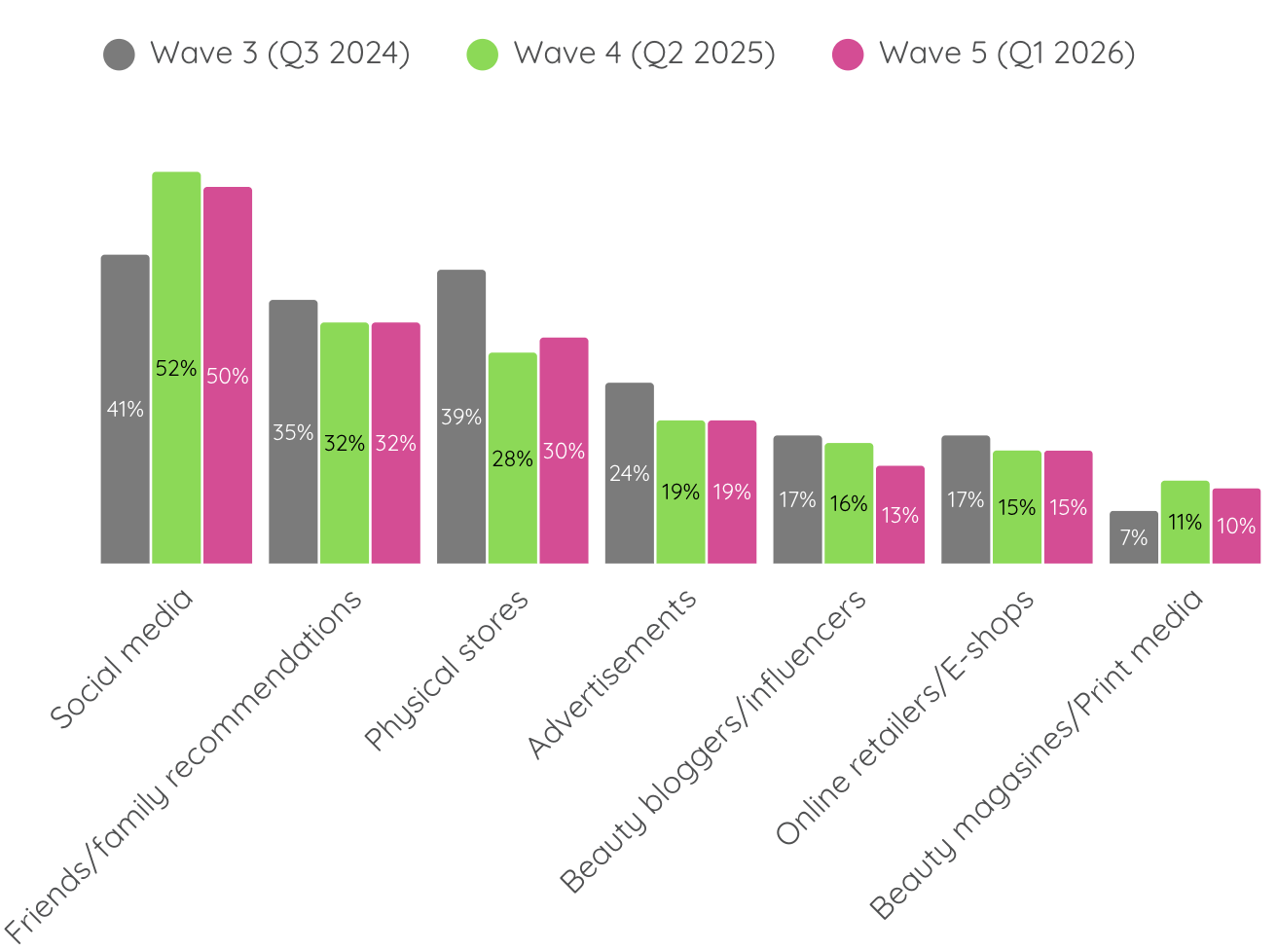
Graph: Opeepl Youth Pulse Study, Wave 4 (Q2 2025) and Wave 5 (Q1 2026)
Social media's role jumped sharply between Q3 2024 and Q2 2025 (41% to 52%), then eased slightly to 50% by Q1 2026 — a levelling-off that, after such a steep initial rise, points to a channel that is maturing rather than one still displacing everything else. Physical stores tell the flip side of that story: they took the sharpest hit of any channel between Q3 2024 and Q2 2025 (39% down to 28%, an 11-point drop) as social media surged, then recovered two points to 30%. Advertisements, friends/family recommendations, and online retailers all held broadly flat or drifted down slightly, none moving enough to change the overall picture.
Two smaller shifts are worth flagging even though the base numbers are modest. "Beauty bloggers/influencers" kept declining (17% to 16% to 13%), even while social media overall held broadly steady — a gap that suggests discovery within social platforms is diversifying away from named influencers specifically. Beauty magasines and print media rose from 7% to 11% then eased slightly to 10%. Given how small this channel is in absolute terms, it's worth treating as a trend to watch rather than a confirmed shift.
Even more personal care & beauty trends in our report. Download your copy.
In-Store Shopping is Still Strong, but Omni-Channel is Gaining Ground
Despite the rise of online shopping, a significant portion of young consumers still prefer to buy personal care products in-store. According to our study, 37% of youth shop for these products in physical stores, while 35% use a combination of in-store and online shopping. This trend highlights the importance of maintaining a strong physical presence while also optimising the online shopping experience.
For young consumers, shopping is not just about convenience but also about the experience. They appreciate the ability to touch, feel, and test products in-store, which helps them make informed decisions. However, the growing tendency to combine in-store and online shopping indicates that brands must offer a seamless omni-channel experience. Whether through click-and-collect services, mobile apps, or virtual try-ons, blending the physical and digital worlds is key to capturing youth attention (Opeepl Youth Pulse Study Wave 2, Q2 2024).
Balancing Sustainability with Practicality: Youth Purchasing Dilemma
Sustainability is a significant concern for young consumers, with 59% of consumers expressing that they care about the sustainability of personal care and cosmetics products. However, when examining youth broader priorities, sustainability ranks only ninth among the causes they care about. This indicates that while sustainability is important, it may not be the leading factor driving their purchasing decisions.
The results of our study suggest that the primary barrier to sustainable consumption is cost, with 56% identifying higher prices as a significant obstacle. Furthermore, while 48% of young consumers acknowledges considering sustainability in their purchasing choices, other factors such as price, brand loyalty, and convenience often take precedence. This complexity reveals that brands must strike a balance between offering sustainable options and ensuring they are accessible and affordable to resonate with Gen Z and younger millennials effectively (Opeepl Youth Pulse Study Wave 2, Q2 2024).
Big Brands Dominate while Niche Brands Carve out Their Space
Findings from our study indicate that Nivea, Dove and L’Oréal reign as the top three personal care brands for young consumers, boasting impressive levels of awareness and consideration. Nivea leads the pack with an awareness rate of 86% and a consideration rate of 65%. Additionally, 45% of young consumers have purchased Nivea products recently, with 37% preferring the brand. Dove follows closely with 78% awareness and 46% consideration, with 40% having bought Dove products recently, and 16% considering it their preferred brand. L’Oréal, while slightly behind, still enjoys strong recognition with 74% awareness and 38% consideration; 26% of youth have purchased L’Oréal products recently, and 11% identify it as their preferred brand.
Top Personal Care Brands among Young Consumers: Brand Funnels
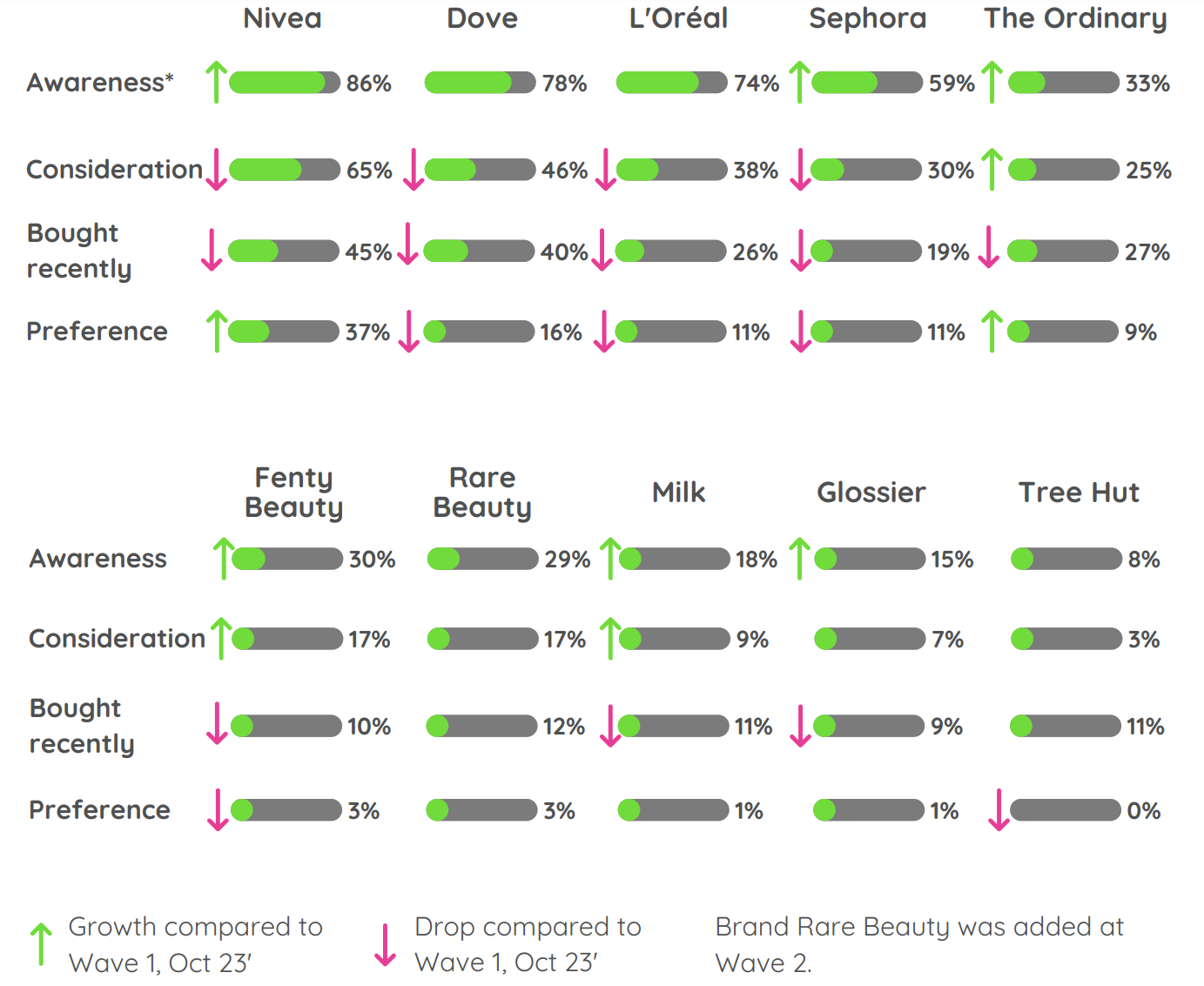
Graph: Opeepl Youth Pulse Study, Wave 2 (Q3 2024)
Despite the dominance of these established brands, the landscape is gradually shifting as niche brands gain traction and appeal. Brands such as Sephora, The Ordinary, Fenty Beauty, Rare Beauty, Milk, and Glossier are becoming increasingly popular among young consumers. Sephora boasts a 59% awareness rate, with 19% of youth purchasing from the brand recently. The Ordinary enjoys 33% awareness, with a notable 27% of youth having bought its products recently. Fenty Beauty and Rare Beauty follow closely, with awareness rates of 30% and 29%, respectively, and recent purchase rates of 10% and 12%. Other niche brands like Milk and Glossier, are also making their mark, with awareness rates of 18% and 15%, and recent purchase rates of 11% and 9%.
This shift toward niche brands indicates that while legacy brands maintain their stronghold, younger consumers are increasingly drawn to innovative, trendy, and inclusive options that resonate with their values and preferences (Opeepl Youth Pulse Study Wave 2, Q2 2024).
Personal Factors Drive Purchases, yet Social Awareness is Rising
When it comes to the factors that drive youg consumers’ purchasing decisions in the category, personal drivers currently outweigh social drivers. Our research from Q4 2023 revealed that personal drivers had a share of 91% in explaining youth recent personal care buying behaviour, with social drivers making up just 9%. However, by Q2 2024, social drivers’ influence had increased slightly to 12%, indicating a growing awareness of social issues among younger consumers.
The top personal drivers when choosing personal care products are brand love (24%), product quality (22%), and how the product enhances their image or reputation (7%). While these personal factors remain dominant, the increasing importance of social drivers suggests that brands cannot afford to ignore their social impact (Opeepl Youth Pulse Study Wave 2, Q2 2024).
Purchase Drivers for Personal Care Products among Youth
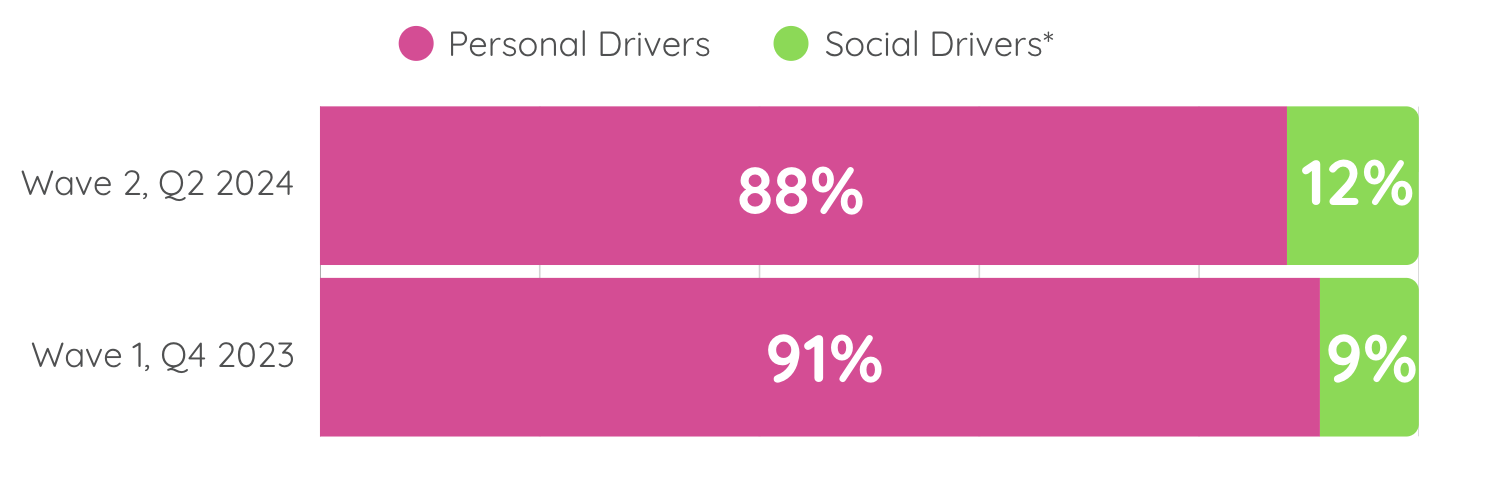
Graph: Opeepl Youth Pulse Study, Wave 2 (Q2 2024). *Examples of Social Drivers: ‘Is taking care of environment’, ‘Is a brand that supports charities’, ‘Is promoting social diversity and inclusion’.
Brand Associations Highlight Youth Values and Preferences
Brand associations play a crucial role in how young consumers perceive various personal care and cosmetics brands. Our research reveals that Dove stands out as a brand closely associated with the attribute of being charitable, resonating with youth strong alignment with social responsibility and philanthropy. This perception positions Dove uniquely in the minds of young consumers, who appreciate brands that contribute positively to society.
In contrast, Glossier and Sephora are primarily associated with being trendy. Young people views these brands as modern and fashionable, highlighting their appeal in the realm of style and aesthetics. This strong perception of trendiness sets them apart from other brands, reflecting their desire for contemporary and fashionable products.
Rare Beauty and Fenty Beauty, on the other hand, are linked with inclusivity. Youth perceives these brands as champions of social diversity and representation, aligning with their values of acceptance and inclusivity. Despite having lower overall awareness than some of the larger brands, their commitment to promoting diversity makes them resonate strongly with young consumers (Opeepl Youth Pulse Study Wave 2, Q2 2024).
Personal Care Brands’ Attributes among Young Consumers
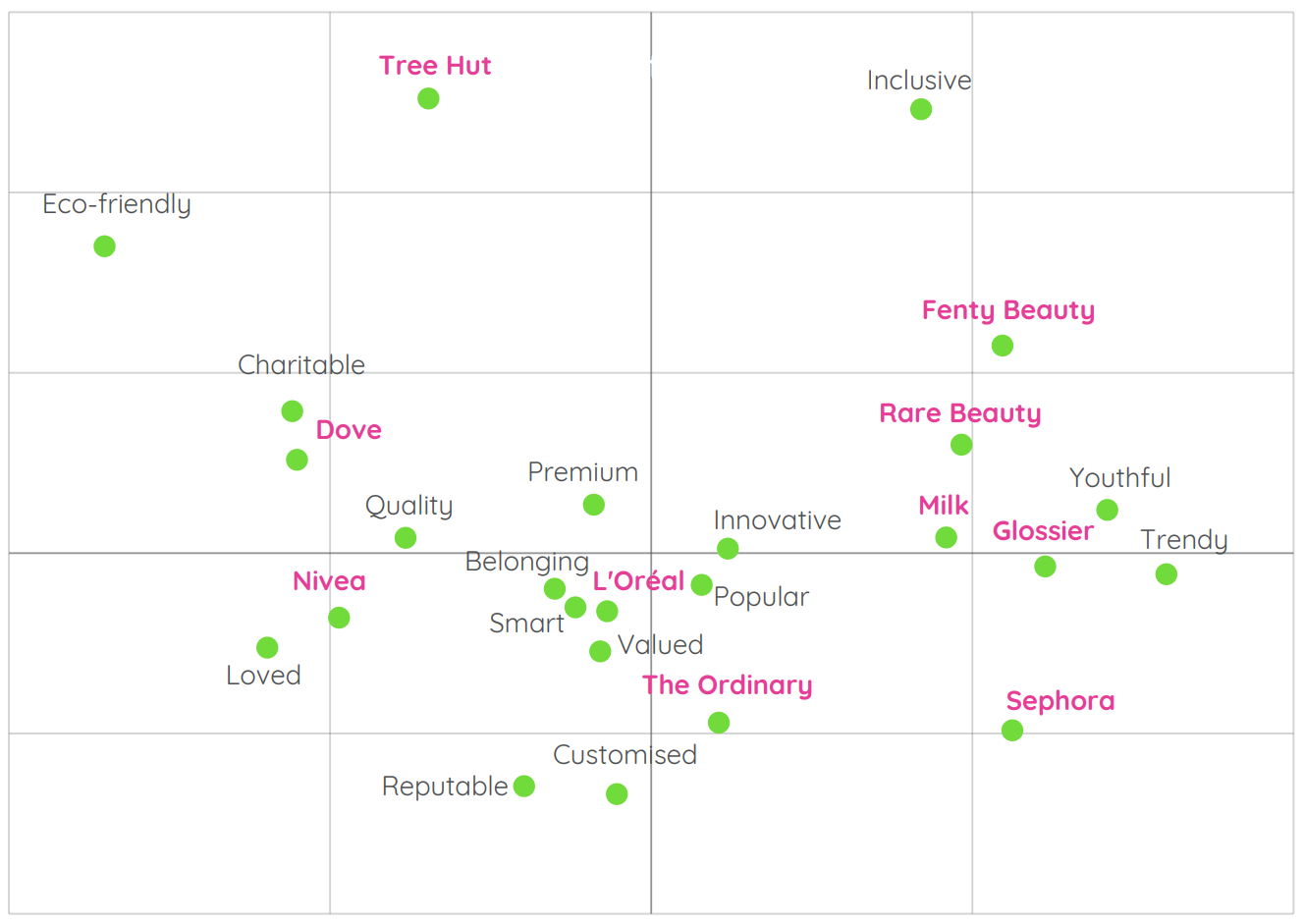
Graph: Opeepl Youth Pulse Study, Wave 2 (Q2 2024). Analysis technique: Correspondence analysis
What This Means for Brands
The personal care and cosmetics category has moved from a channel-and-brand-awareness story in 2024 to a wellness-and-transparency story in 2026. Investment in the category has grown steadily, discovery has consolidated around social media even as physical stores hold their ground, and the trends young consumers say will matter most are increasingly about ingredient honesty, efficacy, and self-care rather than aesthetics alone. Brands that combine credibility, cultural responsiveness, and tangible sustainability action are best placed to connect with Gen Z and younger millennials as the category continues to evolve.

Discover more trends among 15-30 y.o. in Youth Pulse Report
Opeepl Youth Pulse is a bi-annual study that keeps pulse on the latest developments in the youth market. Discover key youth trends in consumer confidence, media habits, attitudes, values, and four major categories: Food, Beverages, Fashion, and Personal Care.