

Social Media Trends Among 15-30 y.o.: How Males and Females Differ in Platforms and Influencer Impact
Updated: June, 2026
Published: July, 2024
In the realm of social media, Gen Z and younger millennials stand out as a highly engaged and digitally-savvy audience. With 94% of young consumers using social media and averaging 3.27 hours a day, their online habits are critical for brands looking to connect with this demographic.
Our research shows that 15-30 year olds are not homogeneous in their social media consumption, and significant gender differences prevail when it comes to platform choices and the effects of influencer marketing. Understanding the nuances of how young males and females interact with social media platforms and influencers can provide invaluable insights for tailored marketing strategies.
Unless otherwise noted, data in this article reflects Wave 5 of our Youth Pulse Study (Q1 2026), covering 15–30 year olds. Some parts draw on Wave 4 (Q2 2025), where those questions were not repeated in later research waves.
The Digital Playground of Youth: Popular Social Media Platforms
Although experiencing a 4 pp decline since Youth Pulse Wave 4 study in April 2025, YouTube continues to be a dominant platform for Gen Z and younger millennials, with a significant 77% of this audience using the platform regularly. It has become a cornerstone of digital media consumption, offering diverse content that resonates with young consumers’ wide range of interests, from entertainment and education to influencer-driven content.
Following closely behind, 74% of 15-30 year olds use Instagram, a platform known for its visual storytelling, influencer culture, and a broad array of lifestyle content (down 1pp since 2025). TikTok, a cultural hub for Gen Z and younger millennials, also experienced a small 2 pp dip since 2025 and now captures the attention of 69% of youth with its short-form video content and viral trends.
X (formerly Twitter) is used by only 23% of Gen Z and younger millennials (down 5pp since 2025), however, it remains relevant as a platform for real-time discussions and trending topics, especially around current events and news. Lastly, Facebook, whose usage had been declining in favour of more visually engaging and faster-paced platforms, is now up 3pp compared to last year with usage at 35%.
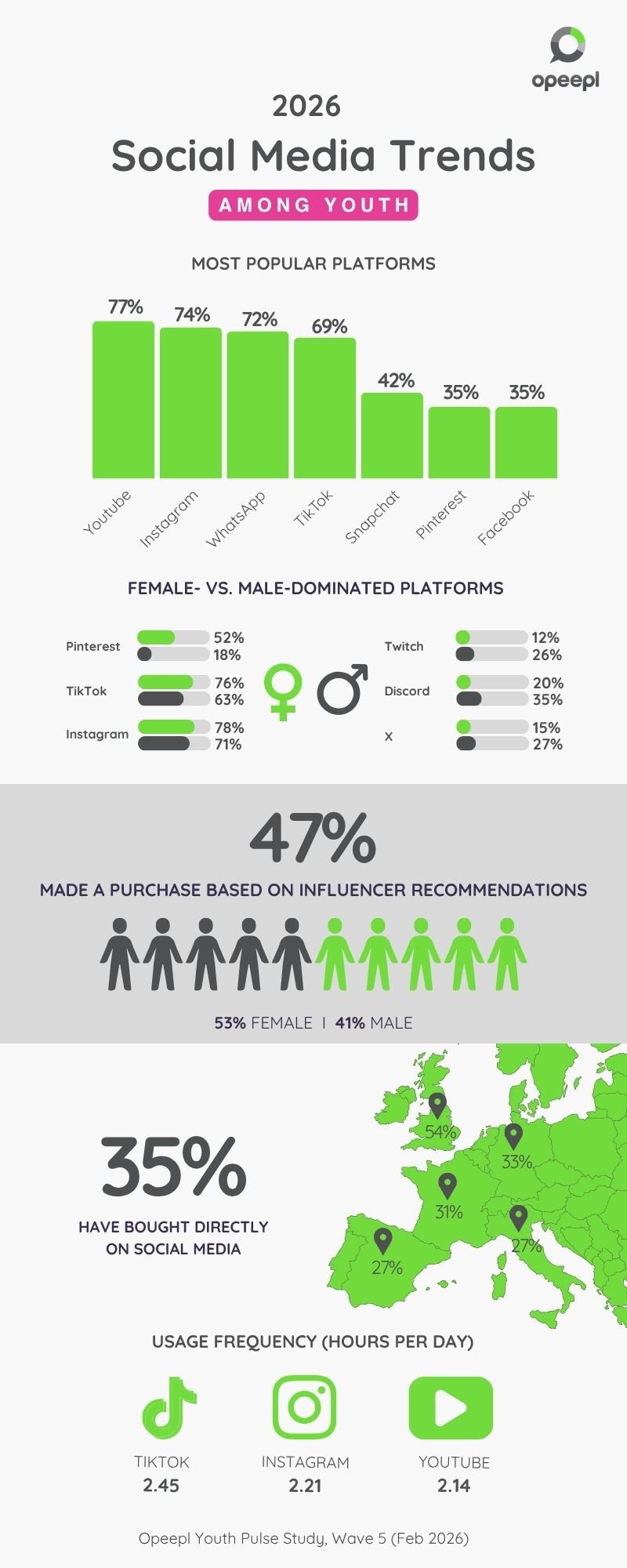
Infographics: Youth Social Media Trends 2026 (Opeepl Youth Pulse Wave 5, Q1 2026)
While YouTube has the highest penetration among 15-30 year olds, TikTok, WhatsApp, and Instagram still boast higher overall usage frequency than YouTube. However, it is interesting to note that YouTube is one of the few platforms where usage frequency has been increasing since 2025.
Usage frequency for the most popular youth social media platforms:
TikTok: 2.45 hours/day (-0.41 h since 2025)
WhatsApp: 2.39 hours/day (added at Wave 5)
Instagram: 2.21 hour/day (-0.1 h since 2025)
Youtube: 2.14 hours/day (+0.11 h since 2025)
Overall, while social media platforms continue to play a central role in Gen Z and younger millennials’ daily lives, there are clear signs of growing awareness around digital wellbeing. Mental health is cited as the top priority for 65% of young consumers in 2026. Moreover, Wave 4 of our Youth Pulse study (April 2025) shows that 35% of 15-30 year olds believe that they spend too much time on social media, while 76% actively take steps to limit their usage.
The slight decline in overall social media usage in 2026 (down 2pp since 2025) and platform engagement reflects not a loss of relevance. Instead, it points to a more conscious and self-regulated approach to social media consumption among youth.
If you’re curious to learn more about how young consumers try to limit their social media time, check our blog post: 👉 How Gen Z and Younger Millennials Use Social Media in 2026: Insights for Brands.
Discover more social media trends among Gen Z and younger millennials in our report. Download your copy.
Female- vs. Male-Dominated Social Media Platforms
While YouTube enjoys nearly equal popularity among both female and male youth (with 76% of females and 78% of males having used it recently), the data reveals a more pronounced gender divide across other prominent social media platforms.
Platforms such as Pinterest, TikTok, and Instagram are dominated by female users, reflecting their preferences for visually-driven and lifestyle-oriented content. For instance, 52% of young females use Pinterest, a platform known for inspiration in fashion, DIY projects, and aesthetic-driven content, compared to just 18% of males. TikTok similarly shows a large gender gap, with 76% of females engaging with the app compared to 63% of males. Its short, dynamic video format appeals strongly to females, especially in areas like beauty, fashion, and viral dance trends. However, gender gaps across these platforms appear to be gradually narrowing. This is particularly evident on Instagram, where female usage declined to 78% and male usage has increased to 71%, reducing the gap to just 7 percentage points in 2026.
Female-dominated social media platforms among 15-30 year olds:
Pinterest: 52% females, 18% males
TikTok: 76% females, 63% males
Instagram: 78% females, 71% males
On the flip side, platforms that are more associated with gaming, tech, and discussion communities tend to be more popular among male youth. For example, Twitch, a live streaming service primarily used for gaming, sees a much larger share of male users (26%) compared to females (12%). Similarly, Discord, which began as a chat platform for gamers but has since expanded to various interest-based communities, is used by 35% of males compared to 20% of females. Reddit, another male-dominated platform known for its vast array of forums and discussions, sees 20% usage among males versus only 11% of females. X (formerly Twitter) also attracts significantly more male users (27%) than female users (19%).
Male-dominated social media platforms among 15-30 year olds:
Twitch: 12% females, 26% males
X: 19% females, 27% males
Discord: 20% females, 35% males
Reddit: 11% females, 20% males
This gender-based preference in social media platform usage reflects not only the different content interests but also how each platform caters to its audience’s social habits. Visual and creative platforms like Pinterest, TikTok, and Instagram align more with young females engagement with lifestyle, self-expression, and influencer content, while platforms like Twitch, Discord, and Reddit foster environments for hobbies like gaming, tech discussions, and niche communities, which tend to draw a larger male audience.
Additionally, the data indicates that 15-30 year olds females are generally more active on social media overall, engaging with their chosen platforms more frequently than their male counterparts. Females, on average, use social media 47.2 times a month compared to males, who average 43.75 times per month (Youth Pulse Wave 4, April 2025). This suggests that beyond just platform preferences, females may integrate social media more deeply into their daily routines, perhaps due to their higher engagement with influencers, lifestyle content, and social interactions online. These trends highlight the nuanced ways in which gender influences digital habits among Gen Z and younger millennials, shaping not only platform preference but also usage intensity.
Female- and Male-Dominated Social Media Platforms: Usage Development 2024-2026
| Platform | Wave 3 (Sep 2024) | Wave 4 (Apr 2025) | Wave 5 (Feb 2026) | |||
|---|---|---|---|---|---|---|
| Women (%) | Men (%) | Women (%) | Men (%) | Women (%) | Men (%) | |
| Female-dominated platforms | ||||||
| 83% | 69% | 81% | 70% | 78% | 71% | |
| TikTok | 76% | 60% | 77% | 65% | 76% | 63% |
| 57% | 15% | 55% | 17% | 52% | 18% | |
| — | — | — | — | 76% | 68% | |
| Gender-neutral platforms | ||||||
| YouTube | 80% | 79% | 82% | 80% | 76% | 78% |
| Male-dominated platforms | ||||||
| Discord | 22% | 35% | 22% | 37% | 20% | 35% |
| 15% | 22% | 14% | 20% | 11% | 20% | |
The Power Players in Youth’s Purchasing Decisions: Social Media Influencers
Influencer marketing plays a significant role in shaping the purchasing decisions of Gen Z and younger millennials, and our study reveals that the power of social media influencers is on the rise again. 47% of 15-30 year olds have purchased a product because it was recommended by a social media influencer, which is up 3pp from 2025. This influence is more pronounced among females, with 53% having made purchases based on influencer recommendations, compared to 41% of males.
Furthermore, 25% of Gen Z and younger millennials trust influencer marketing more than traditional advertisements, with this sentiment shared equally between males and females. While trust in influencer marketing is consistent across genders, females remain more likely to act on influencer recommendations, suggesting that factors beyond trust - such as engagement, relatability, or content format - may play a greater role in driving their purchasing decisions.
Brands aiming to connect with young females should prioritise collaborations with influencers who align with their values and can authentically represent their products. Given the higher purchasing influence among young females, influencer partnerships can significantly enhance brand reach and impact within this demographic.
For young males, while trust in influencer marketing is on par with females, the lower rate of acting on recommendations suggests that other factors may be shaping their purchasing journeys. Brands targeting males should consider a balanced approach that incorporates both influencer collaborations and other trusted marketing channels to drive conversion.
To learn more about the power of social media influencers among youth, check out this blog post: 👉 How Social Media Influencers Are Shaping Youth Buying Habits
Strategic Implications for Brands: Connecting with Gen Z and Younger Millennials on Social Media
To effectively engage with Gen Z and younger millennials on social media, brands need to:
1. Play to Platform Preferences: Recognise that while YouTube is universally popular, Instagram, TikTok, and Pinterest hold a special appeal for females. Tailor content to suit these preferences, using visual and interactive elements that resonate well with this audience. Conversely, brands targeting males should focus on Twitch, Discord, and Reddit, where engagement is higher among this group.
2. Harness Influencer Power: Understand the power of influencers in driving purchasing decisions, especially among females. Choose influencers who can authentically represent the brand and build trust with their followers.
3. Create Relatable Content: Develop content that is relatable and credible, particularly for females who trust influencers more than traditional advertisements. For males, consider content that is both entertaining and educational.
By understanding and leveraging these youth social media trends, brands can create more effective and targeted strategies to connect with Gen Z and younger millennials. This approach not only enhances engagement but also builds stronger, more meaningful relationships with this digitally-savvy audience.

Discover more trends among 15-30 y.o. in Youth Pulse Report
Opeepl Youth Pulse is a bi-annual study that keeps pulse on the latest developments in the youth market. Discover key youth trends in consumer confidence, media habits, attitudes, values, and four major categories: Food, Beverages, Fashion, and Personal Care.