
How Gen Z and Younger Millennials Use Social Media: Insights for Brands
Updated: June, 2026
Published: October, 2025
Social media is still the heartbeat of daily life for young people, but their relationship with it is maturing. What once felt like passive, endless scrolling is increasingly something young people are making active choices about — when to engage, how much, and on which platforms.
The Youth Pulse Wave 5 study shows that 94% of 15–30-year-olds use social media in 2026. Compared to Q2 2025, overall usage is down slightly (-2pp), and the two biggest platforms, YouTube and TikTok, have also eased back a little. But the bigger story is what's happening underneath the headline numbers: gender gaps on key platforms are shifting in surprising directions, and where attention actually goes doesn't always match where reach is highest.
This generation isn't just doom-scrolling; they're redefining what social media is for.
Let's dive in.
Which Platforms Rule Young People's Lives
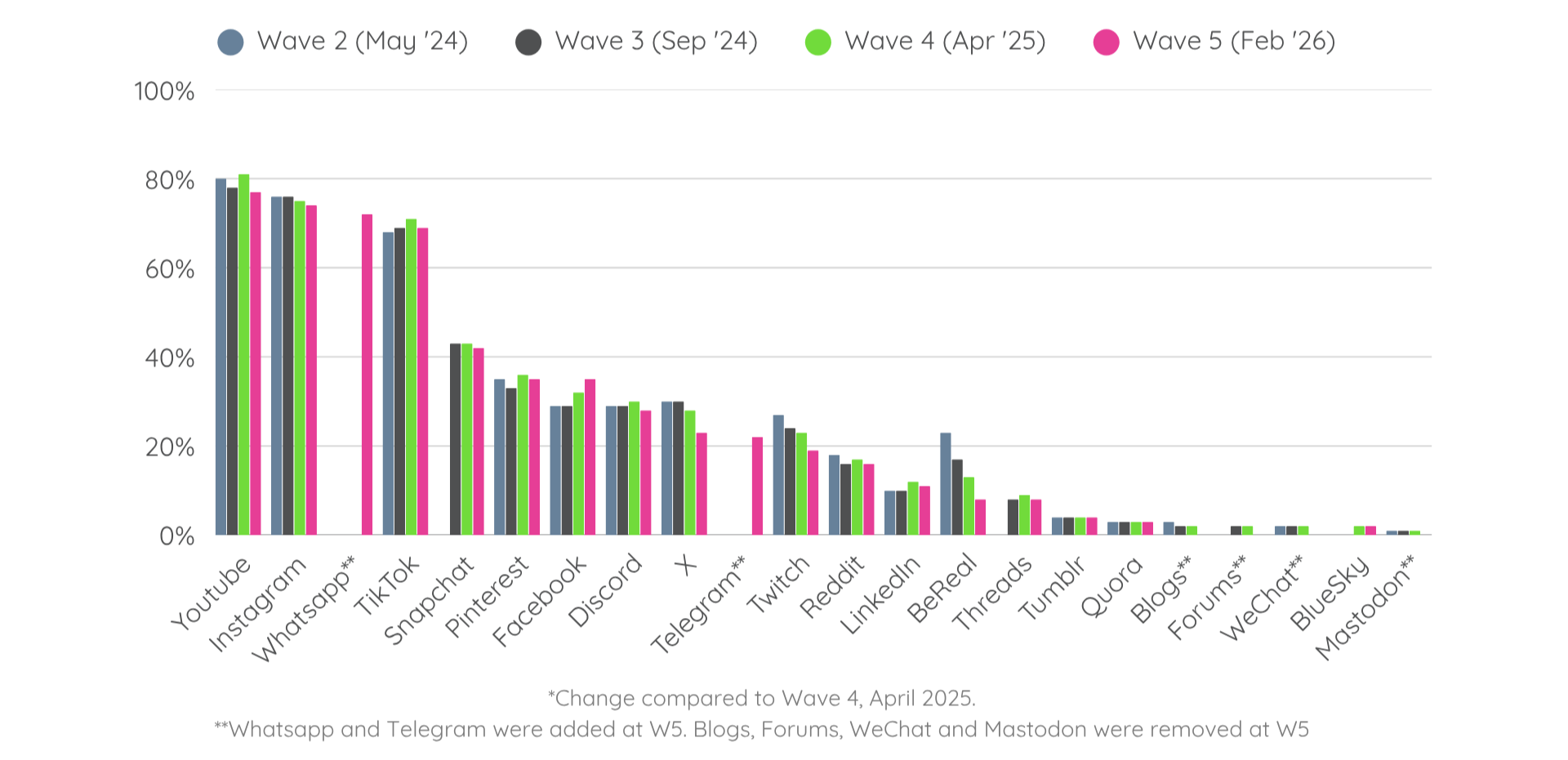
The data confirms the established hierarchy, with a few small shifts since Q2 2025:
YouTube: 77% (down 4pp from Q2 2025)
Instagram: 74% (down 1pp)
WhatsApp: 72% (newly tracked in Wave 5)
TikTok: 69% (down 2pp)
Snapchat, Pinterest, Facebook and Discord round out the next tier, each sitting roughly between 24–35% usage. Telegram was also added as a tracked platform for the first time in Wave 5 (Q1 2026).
Why do young people use these platforms? Because it's where everything happens: discovering trends, chatting with friends, following creators, and staying in the loop with what their circles are up to.
For brands, this means there is no single platform that reaches all youth. A presence on YouTube delivers the widest reach, but TikTok and WhatsApp are where attention and daily habit actually live.
Popularity of Social Media Platforms Among Gen Z and Younger Millennials
Source: Opeepl Youth Pulse Study, Waves 2-5 (Q2 2024 – Q1 2026)
Across all these platforms, we also see a consistent gender divide: visual and lifestyle-driven spaces like Instagram, TikTok and Pinterest skew strongly female, while gaming and community platforms like Discord and Reddit lean male. These gaps have remained stable since Q2 2024, suggesting they reflect deep-rooted preferences rather than short-term trends.
For a full breakdown of how male and female youth differ across platforms, influencer engagement and purchasing behaviour, read our dedicated post: Social Media Trends among Gen Z and Younger Millennials: How Males and Females Differ in Platforms and Influencer Impact.
Discover more about 15–30-year-old consumers’ social media habits in our latest Youth Pulse Report
How Much Time Gen Z and Younger Millennials Spend on Social Media
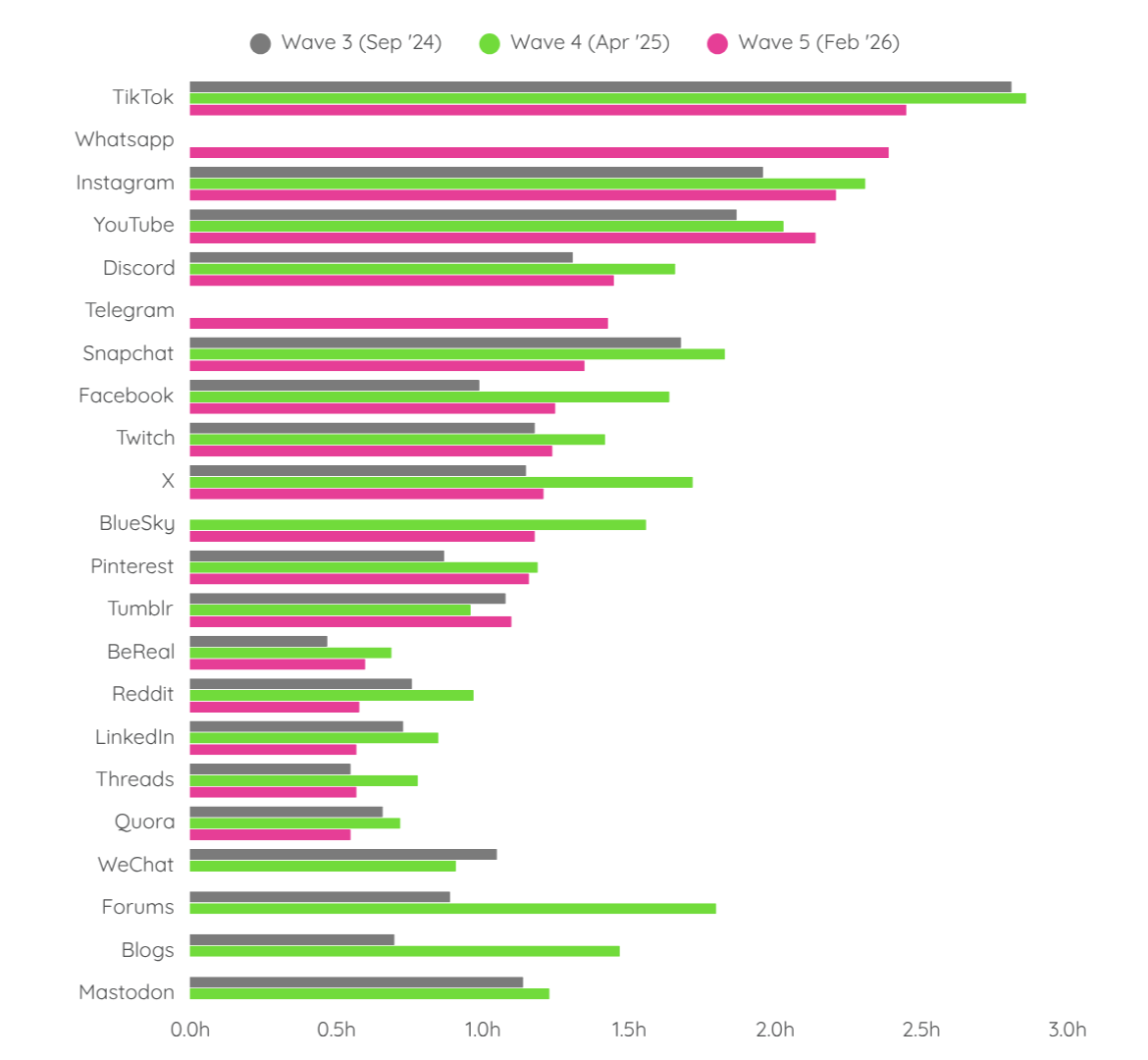
The data tracked average daily time spent per platform, and the picture is one of concentration rather than spread. Despite YouTube having the highest reach among youth (77%), it is not where young people spend the most time.
The top platforms by daily time spent in 2026 are:
TikTok: 2.45h — still the clear leader for time spent, though down from 2.86h in Q2 2025
WhatsApp: 2.39h — newly tracked in Wave 5, it immediately ranks among the highest time-consuming apps, reflecting how central messaging has long been to daily routines
Instagram: 2.21h — close behind, down slightly from 2.31h in Q2 2025
YouTube: 2.14h — high reach but lower daily time than the short-form leaders, and notably the only platform among the top four where time spent actually increased (up from 2.03h in Q2 2025)
TikTok's average daily time dropped by over 20 minutes compared to Q2 2025, and most other platforms followed the same downward pattern: Discord (1.66h → 1.45h), Snapchat (1.83h → 1.35h), Facebook (1.64h → 1.25h), Twitch (1.42h → 1.24h), X (1.72h → 1.21h) and BlueSky (1.56h → 1.18h) all lost time. Snapchat's drop is the steepest of the group, shedding nearly 30 minutes of average daily use in under a year.
YouTube stands out as the clear exception: it gained time (+0.11h) even as most other platforms lost it. Together with WhatsApp's strong debut, this suggests some users are consolidating their attention onto fewer, longer-form or utility-driven destinations rather than spreading it thinly across many apps. For brands, the implication is pointed: reach and attention do not always move together. A platform can lose users and still capture more of the time that remains.
Daily Time Spent on Social Media Platforms Among Young Consumers
Source: Opeepl Youth Pulse Study, Waves 3-5 (Q3 2024 – Q1 2026)
76% Have Taken Steps to Limit Their Social Media Use
Findings from Wave 4 of the Youth Pulse Study (Q2 2025) remain a useful backdrop for understanding why youth behaviour is shifting the way it is.
We asked Gen Z and younger millennials whether they think they spend too much time on social media, and here's a breakdown of the results:
35% of youth think they spend too much time on social media
42% feel like they have some control over it
35% think their usage is balanced
4% try to avoid social media (Opeepl Youth Pulse Study Wave 4, Q2 2025).
This self-awareness about screen time translates into concrete behaviour. We asked 15–30-year-olds whether they had ever taken active measures to limit their time on social media. The results show a generation that is not just aware of the issue but actively doing something about it: 76% had already taken at least one concrete step to manage their consumption, while only 15% said they felt no need to limit their usage at all.
Most Popular Techniques to Limit Social Media Time Among 15-30 y.o.
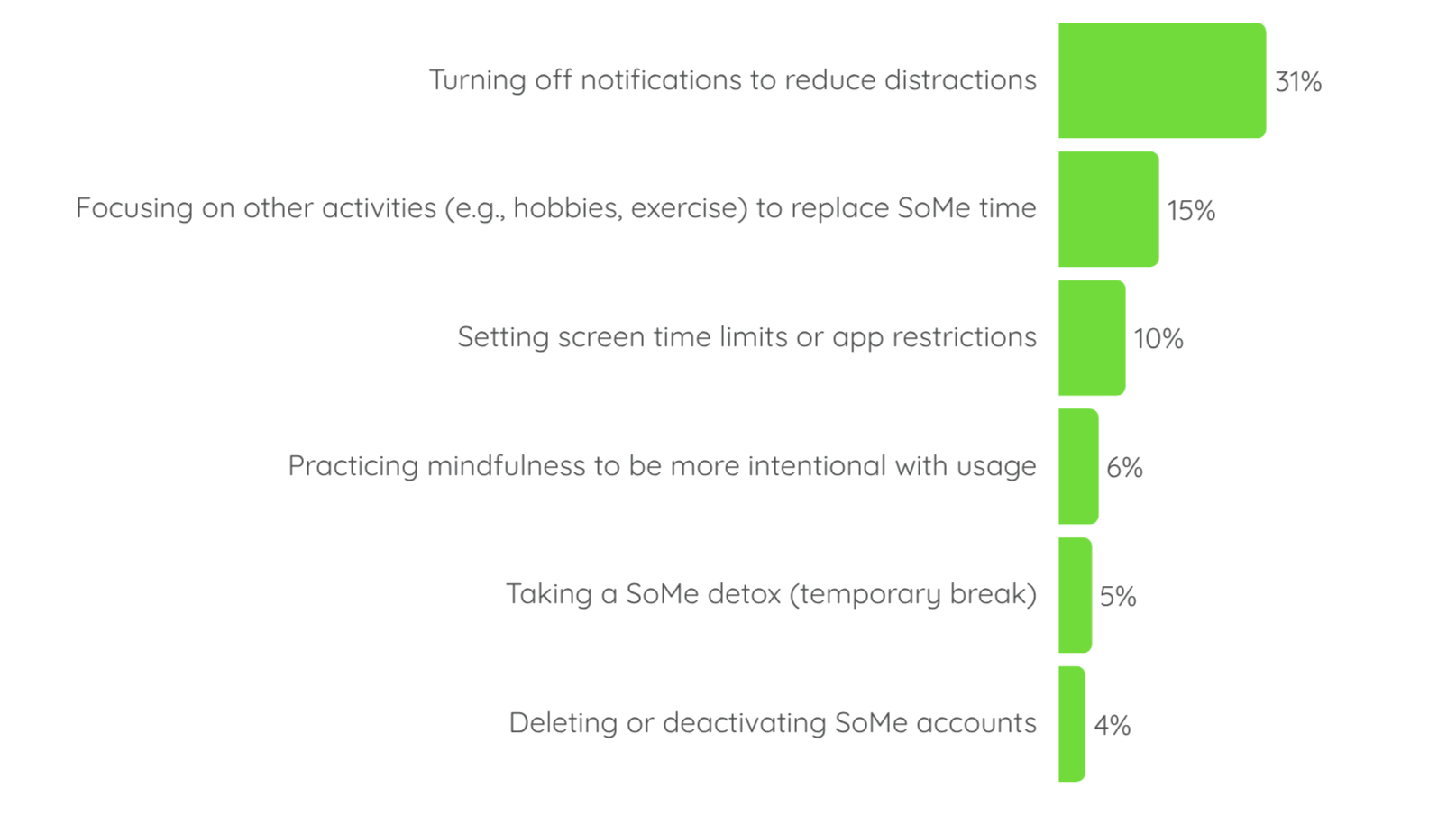
Source: Opeepl Youth Pulse Study, Wave 4 (Q2 2025)
Among those who had taken action, the most common techniques were:
31% turned off notifications to reduce distractions
15% focused on replacing social media time with other activities such as hobbies or exercise
10% set screen time limits or in-app restrictions
6% practised mindfulness to be more intentional with their usage
5% took a temporary social media detox
4% deleted or deactivated accounts entirely
The picture is one of pragmatic, low-friction choices: most youth are not quitting social media, but they are building small guardrails around it. Turning off notifications is the most popular step precisely because it disrupts compulsive checking without requiring a full behavioural overhaul.
Social Commerce: 35% Bought Directly on Social Media
The way Gen Z and younger millennials shop is shifting alongside where they spend their time. 35% of 15–30-year-olds had bought something directly on social media, up 7 percentage points from Q2 2025, where that figure stood at 28%. And the pipeline of potential buyers is significant: an additional 28% said they had considered it but not yet made a purchase, meaning that nearly two thirds of European youth are either already buying on social media or open to doing so. The share who prefer traditional online shopping dropped 8 points in the same period, from 44% to 36%, a clear signal that resistance to social commerce is softening.
The country-level picture is just as telling, and shows both the leading market and where momentum is building fastest.
Percentage of Young Consumers in EU5 Who Bought Directly on Social Media: Country Split
| Country | Wave 4 (Apr 2025) | Wave 5 (Feb 2026) |
|---|---|---|
| Bought directly on social media (%) | Bought directly on social media (%) | |
| UK | 50% | 54% |
| Germany | 25% | 33% |
| France | 22% | 31% |
| Italy | 24% | 27% |
| Spain | 20% | 27% |
Source: Opeepl Youth Pulse Study, Wave 4 (Q2 2025) and Wave 5 (Q1 2026). Q: "Have you ever bought something directly from social media (e.g., TikTok Shop, Instagram Shopping)?" — % who answered yes (many times or once/twice).
The UK remains the clear leader, with more than half of young consumers already buying directly on social media. But the most striking shifts are happening on the continent: France jumped 9 points and Germany 8 points since Q2 2025, suggesting that social commerce in these markets is moving from early adoption into something closer to mainstream behaviour. Italy and Spain are growing more gradually, but both moved in the same direction.
The Influencer Effect: Bouncing Back
Social media purchasing does not happen in a vacuum. Influencers remain a powerful force in shaping what young people buy: 47% of 15–30-year-olds had purchased a product based on an influencer recommendations, recovering from a dip to 44% in 2025. Trust in influencers over traditional advertising also rose to 25% in Q1 2026 — its highest level since the Youth Pulse study began tracking it.
For a deeper look at how influencer marketing is actually driving youth purchase decisions, and what brands should do about it, read our dedicated post: How Social Media Influencers Are Shaping Youth Buying Habits.
What This Means for Brands
Youth's relationship with social media keeps evolving in small but meaningful ways. Reach for the giants — YouTube, Instagram, TikTok — has eased slightly, but engagement is consolidating: people are spending more time on fewer apps, even as their overall usage of any single platform dips a little.
What's also clear is that young people are increasingly conscious of how they spend that time. Most have already taken steps to limit their usage, from turning off notifications to setting screen time boundaries, reflecting a generation that is engaging with social media on its own terms.
For brands, the message is clear: meaning, not manipulation, and value over volume. Attention is harder to win and easier to lose, but the platforms where young people spend the most time aren't always the ones with the highest reach, and that gap is where the real opportunity lies.

Discover more trends among 15-30 y.o. in Youth Pulse Report
Opeepl Youth Pulse is a bi-annual study that keeps pulse on the latest developments in the youth market. Discover key youth trends in consumer confidence, media habits, attitudes, values, and four major categories: Food, Beverages, Fashion, and Personal Care.