
Youth Fashion Trends 2026: Second Hand Growth and 10 Trends to Watch
Updated: July 2026
Published: April, 2026
Gen Z and younger millennials are no longer just following fashion, they're rewriting the rules of how it's bought, worn and valued. Today's 15–30-year-olds are balancing affordability, identity, comfort and sustainability all at once, and Youth Pulse Study lets us track exactly how that balance has shifted over the months. From the rise of second-hand shopping to the trends reshaping wardrobes in 2026, here's what brands need to know.
Unless otherwise noted, data in this article reflects Wave 5 of our Youth Pulse Study (Q1 2026), covering 15–30 year olds. Some sections draw on Wave 3 (Q3 2024), which covered a slightly narrower age group of 15–27 year olds, where those questions were not repeated in later research waves.
Key Drivers of Youth Fashion Purchases
Before looking at key fashion trends for 2026, it's worth understanding where young consumers get inspiration for their fashion purchases, what actually gets them to buy, and where they shop for apparel.
Our Youth Pulse study shows that social media is the top source of fashion inspiration, with 43% of young shoppers turning to platforms like Instagram and TikTok to discover trends. Despite the digital shift, physical stores continue to play a key role, with 40% of youth drawing style inspiration from in-store browsing (Opeepl Youth Pulse Study Wave 3, Q3 2024).
Where young consumers get inspiration for their fashion purchases:
Social Media: 43% get inspiration on various social platforms
Physical Stores: 40% get ideas from in-store browsing
Online Retailers: 29% explore e-commerce sites for fashion ideas
Friends & Family: 28% rely on word-of-mouth recommendations
Street Style: 28% are influenced by everyday fashion
Fashion Bloggers & Influencers: 14% turn to trendsetters
TV Shows & Celebrities: 12% get inspiration from pop culture
Fashion Magazines: 12% still appreciate traditional media
Price, style and quality remain the dominant purchase factors among Gen Z and younger millennials: 57% cite affordability as the top consideration, 54% prioritise style and design, 49% look for quality and durability, 34% favour convenience, and 25% weigh brand reputation (Opeepl Youth Pulse Study Wave 3, Q3 2024).
Where Young Consumers Buy Fashion Products
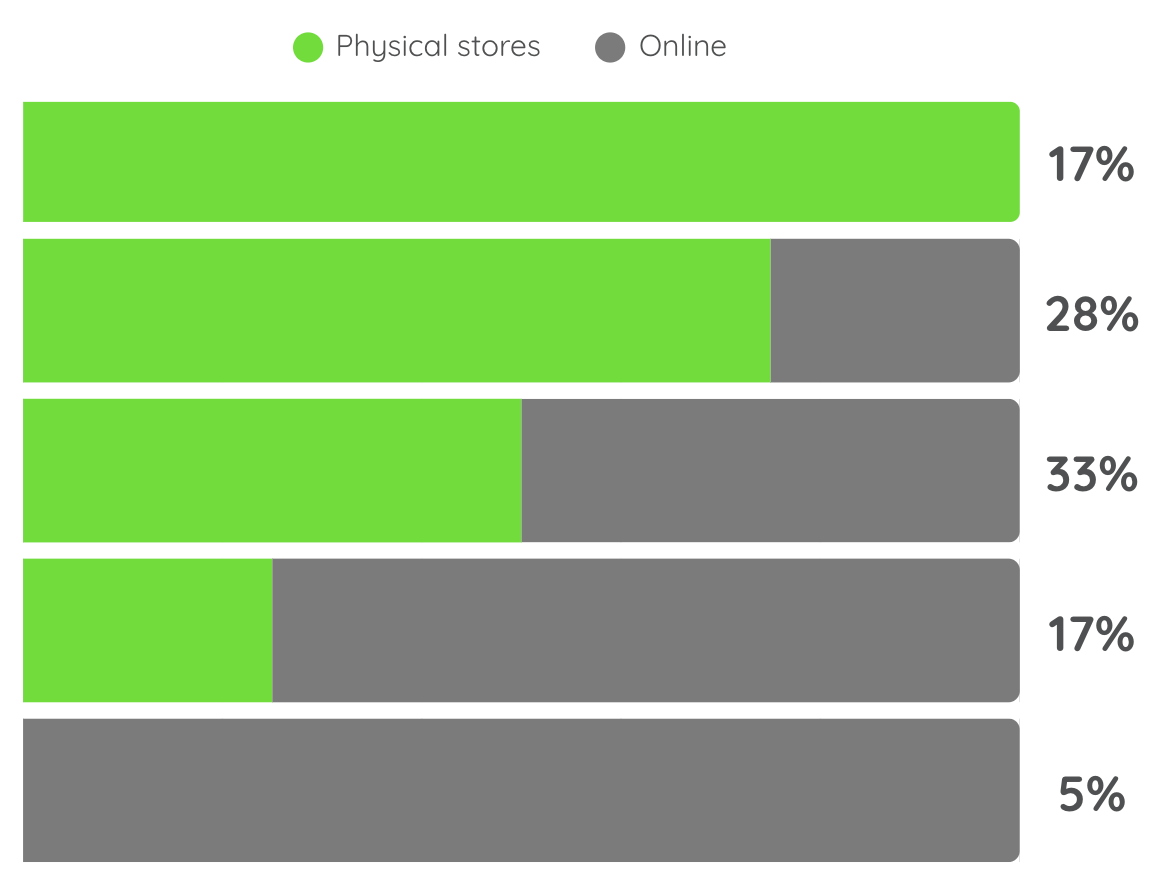
Graph: Opeepl Youth Pulse Study, Wave 3 (Q3 2024)
Online shopping has become an integral part of how young consumers engage with fashion, with 83% making apparel purchases online. However, physical stores still play an important role in their shopping journey - 17% of youth shop exclusively in-store, while only 5% rely solely on online platforms. The majority (78%) embrace a hybrid approach, blending digital convenience with in-person experiences. The hybrid pattern isn't evenly split by gender though: online apparel shopping is more common among women (87%) than men (79%), an eight-point gap that's worth factoring into channel strategy rather than treating young consumers as one undifferentiated online-first audience.
10 Fashion Trends To Watch In 2026
To spot relevant trends among Gen Z and younger millennials in the fashion category, half of the respondents in the study were asked an open-ended question: 'What new trend in the fashion (e.g., clothes, accessories) category have you noticed recently that you think will become increasingly important for consumers?’. The open-ended responses were grouped to find patterns or small-but-growing ideas that kept emerging.
The other half of respondents were asked to rank the identified re-emerging trends: ‘Which trend do you think will matter most to people when choosing fashion products in the future?’
The trends were ranked 1–5, where 1 = Highest Rank, 5 = Lowest Rank.

Youth is shifting toward practical, relaxed everyday clothing, like oversized tees, hoodies and cargos, driven by comfort, ease of styling and streetwear culture.

Increased visibility and aspiration around luxury brands shaping mainstream style cues, through runway influence, collaborations, and viral “it items” that signal status and taste.

A throwback to early-2000s and '90s styles – low-rise jeans, baby tees, mini bags, butterfly clips, and metallic tones. Young consumers are nostalgic for the culture of their childhoods.

Youth appreciate integration of technology into fashion: smart fabrics and wearable features, but also “fashion tech” experiences like virtual try-on and digital personalisation.

Young people are demanding ethical production and environmental responsibility: brands communicating sourcing, labour practices and materials more clearly.

Growing focus on elevating outfits through accessories, like bags, belts and hats. Youth use them as intentional “statement” pieces to define their look, not just as functional add-ons.

Youth are interested in extending product life through second-hand, vintage and upcycled clothing, positioning circular consumption as a style choice and a sustainability action.

Influenced by queer culture, TikTok influencers and celebrities, young people increasingly reject rigid gender norms. Fashion is seen as a tool for identity exploration and inclusion.

Youth move toward understated style, like neutral palettes, clean cuts and premium basics, favouring discreet quality and longevity over logos, trend churn and status signalling.

Young people continue blending performance and casual wear, like leggings, sneakers and sporty silhouettes, designed for comfort, versatility and all-day use beyond the gym.
*Ranked 1–5, 1 = Highest Rank, 5 = Lowest Rank. Source: Opeepl Youth Pulse Study, Wave 5 (Q1 2026).
Second-Hand Fashion: From Rising Trend To Mainstream Habit
Second-hand fashion has moved fast enough since Wave 3 in 2024 that it's worth slowing down and looking at the data. The table below breaks out exactly how youth split their fashion budget between new and second-hand, from those buying nothing but new, to those buying nothing but pre-owned, across all three waves.
Distribution Between New and Second-Hand Fashion Purchases Among Young Consumers
| Purchase Mix | Wave 3 (Sep 2024) | Wave 4 (Apr 2025) | Wave 5 (Feb 2026) |
|---|---|---|---|
| 100% new, 0% second-hand | 37% | 22% | 23% |
| 75% new, 25% second-hand | 30% | 31% | 34% |
| 50% new, 50% second-hand | 20% | 29% | 27% |
| 25% new, 75% second-hand | 10% | 13% | 11% |
| 0% new, 100% second-hand | 4% | 5% | 5% |
| Buys at least some second-hand | 63% | 78% | 77% |
Source: Opeepl Youth Pulse Study, Waves 3-5 (Q3 2024 – Q1 2026). Q: "How are your fashion purchases distributed between new and second-hand?"
Our research shows that 77% of Gen Z and younger millennials buy second-hand clothing, with 5% buying exclusively second-hand clothes. The popularity of second-hand grew by 14 percentage points since Q2 2024. Looking at the full picture reveals this growth wasn't just more people dabbling in second-hand — it was a genuine shift in how people shop. Between Q3 2024 and Q1 2026, the "exclusively new" group nearly halved (37% → 23%), while the 50/50 mixed-shopper segment grew the most of any bucket (20% → 27%). In other words, second-hand isn't just being added at the margins by a few committed buyers — a large middle segment of mainstream shoppers has genuinely rebalanced their wardrobe between new and pre-owned. So rather than adoption continuing to deepen, the Q1 2026 data suggests youth who do mix in second-hand are, on average, leaning slightly lighter on it than they were six months earlier.
Discover more about Gen Z and younger millennials’ fashion. Download the full report.
When Gen Z and younger millennials are asked why they buy second-hand, three motivations lead the way: cost savings and affordability (57%), unique or vintage finds (36%), and sustainability and environmental concerns (31%).
Motivations for buying second-hand have shifted in interesting ways between Q3 2024 and Q1 2026. The numbers don't all move in the same direction, and that's worth sitting with rather than smoothing over:
Cost is the one constant: it's the top motivation in every period we've measured and keeps edging up, which tracks with the financial pressure younger consumers are under.
Sustainability tells a messier story: it jumped nine points between Q3 2024 and Q2 2025, then slipped back in Q1 2026. That could be genuine "sustainability fatigue" as second-hand becomes routine rather than a statement.
The clearer trend is personal style and individuality, which has fallen steadily from 37% to 23% across the period. As second-hand shopping shifts from subculture signal to default behaviour, it seems to be losing some of its power as a form of self-expression — buying pre-owned is increasingly just "normal," not a statement.
Motivations for Choosing Second-Hand Fashion Among Young Consumers
| Motivation | Wave 3 (Sep 2024) | Wave 4 (Apr 2025) | Wave 5 (Feb 2026) |
|---|---|---|---|
| Cost savings and affordability | 53% | 56% | 57% |
| Unique or vintage finds | 32% | 36% | 36% |
| Sustainability and environmental concerns | 24% | 33% | 31% |
| Personal style and individuality | 37% | 27% | 23% |
| Supporting local businesses or charities | 18% | 18% | 21% |
| Quality of items compared to fast fashion | 25% | 16% | 16% |
Source: Opeepl Youth Pulse Study, Waves 3-5 (Q3 2024 – Q1 2026). Q: "What is your top three motivations to purchase second-hand clothing?"
The Sustainability Paradox: Awareness versus Action
Awareness of fashion's sustainability problem runs high among young consumers, turning that awareness into different buying behaviour is another matter. Asked whether they agree that the fashion industry has a sustainability problem, 59% say that they agree with the statement. 24% said that they neither agree nor disagree, 5% disagree, and 12% are indifferent about the issue.
Youth’s agreement with the statement: ‘The fashion industry has a sustainability problem’
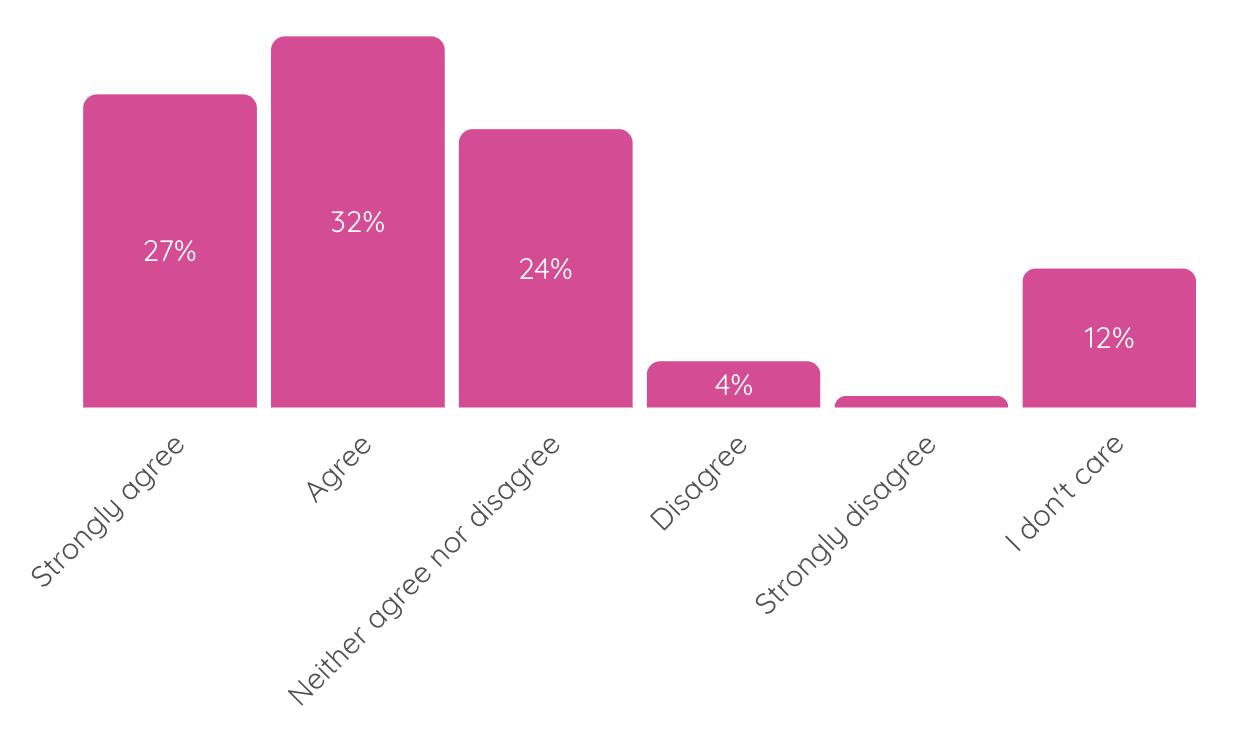
Graph: Opeepl Youth Pulse Study, Wave 3 (Q3 2024)
However, our research shows that only 30% say sustainability actually factors into their decisions when it comes fashion purchases: roughly half the share who acknowledge the issue exists. That gap between belief and behaviour lines up with what the second-hand motivations data above already suggested: sustainability matters to youth in principle, but it rarely wins out over cost, style or convenience at the actual point of purchase (Opeepl Youth Pulse Study Wave 3, Q3 2024).
There's a more encouraging number sitting alongside that gap, though: 66% of youth say they're willing to pay more for sustainable fashion, with an average premium they'd accept of around 10%. Read together, these numbers suggest the barrier isn't conviction — most young consumers already believe sustainability matters — it's that sustainable options too often ask for a bigger premium, or demand more effort, than most are willing to give without a clear, transparent reason to do so. For brands, that points toward a fairly specific opportunity: pairing sustainability claims with real affordability and clear transparency, rather than treating sustainability as a premium positioning play on its own.
What This Means For Fashion Brands
Based on the research findings, a few strategic priorities stand out for brands targeting Gen Z and younger millennials:
Treat second-hand as core infrastructure, not a side initiative. With adoption essentially flat in the high-70s (78% → 77%), resale and trade-in programmes should be built into the core retail model, not bolted on.
Don't assume sustainability messaging alone will move the needle. Its appeal as a second-hand motivation has softened slightly since Q2 2025. Affordability and uniqueness still do more of the work.
Balance affordability with style and durability. Price gets attention, but quality and design decide loyalty.
Invest in both digital and physical retail. Hybrid shopping isn't going away, and fashion tech (virtual try-on, digital personalisation) is becoming a genuine differentiator, not a novelty.
Build flexible identities, not rigid collections. Gender-neutral styling, quiet luxury and relaxed streetwear are coexisting comfortably in the same wardrobes. Young consumers are mixing aesthetics rather than committing to one.
The insights from our Youth Pulse Study tell a consistent story: young consumers are not chasing a single look. They are building wardrobes around comfort, affordability, identity and conscience simultaneously. Second-hand has gone from a fast-rising trend to a stable habit. Sustainability, while still important, is no longer the only, or even the primary, reason youth shops pre-owned. And the 2026 trend list shows a generation pulling in genuinely different directions at once: nostalgic and futuristic, status-conscious and quietly minimal, individualistic and increasingly community-minded. Rather than chasing trends one at a time, brands that succeed with this generation will be the ones tracking how these priorities move, and moving with them.

Discover more trends among 15-30 y.o. in Youth Pulse Report
Opeepl Youth Pulse is a bi-annual study that keeps pulse on the latest developments in the youth market. Discover key youth trends in consumer confidence, media habits, attitudes, values, and four major categories: Food, Beverages, Fashion, and Personal Care.