
How Social Media Influencers Are Shaping Youth Buying Habits in 2026
Updated: June, 2026
Published: July, 2025
When was the last time you bought something because you saw it in a TV ad?
For most young people today, the answer is probably "I can't remember." The real influence happens on their phones, in the scroll of a feed, through the voices of creators they trust.
For Gen Z and younger millennials, social media influencers aren't just background noise; they shape what young consumers wear, eat, play, and even believe in. And the latest data from Youth Pulse Wave 5 (Q1 2026) confirms that this influence isn't fading. If anything, it's getting sharper.
So the question isn't "Do influencers still matter?" It's "How has their role evolved — and why do young consumers still trust them?"
91% of Young Consumers Follow Influencers on Social Media
Influencer engagement among Gen Z and younger millennials is now nearly universal: 91% follow influencers on social media. This isn't a niche behaviour anymore. Influencers have become a standard part of how young people consume content, discover products, and form opinions about brands.
Not all platforms play the same role in how young people engage with influencers. The data is clear: TikTok leads, YouTube holds its ground with men, and Instagram sits comfortably in the middle.
Top Platforms for Engaging with Social Media Influencers among 15-30 y.o.
| Platform | Wave 4 (Apr 2025) | Wave 5 (Feb 2026) | ||||
|---|---|---|---|---|---|---|
| Total | Gender split | Total | Gender split | |||
| ♂ Male | ♀ Female | ♂ Male | ♀ Female | |||
| 🎵 TikTok | 39% | 30% | 49% | 39% | 30% | 49% |
| 24% | 22% | 27% | 26% | 25% | 27% | |
| ▶️ YouTube | 22% | 30% | 15% | 20% | 27% | 13% |
Source: Opeepl Youth Pulse Study, Wave 4 (Q2 2025) and Wave 5 (Q1 2026). Q: "On which platform do you engage the most with influencers?"
TikTok has held its dominant position between Q2 2025 and Q1 2026, driven largely by its short-form format and algorithm-powered discovery. But the gender split tells the deeper story.
Females are significantly more likely to engage with influencers on TikTok, while males show stronger engagement with YouTube. Instagram is the only top platform where engagement is close to balanced across genders.
For brands, this means platform strategy isn't just about reach — it's about who you're actually reaching and how.
Entertainment Influencers Dominate among 15-30 y.o.
Entertainment influencers dominate among 15–30-year-olds, and that's no accident.
When young people open TikTok or Instagram, they're not looking to be sold to. They're looking to laugh, feel something, or escape for a few minutes. The creators who earn their attention first are the ones who deliver on that, and product discovery follows as a natural byproduct.
Entertainment influencers focusing on humour, memes, storytelling, or pop culture remain the most followed among youth, at 34%. Gaming holds second place at 27%. Food & cooking influencers are followed by 22%, completing the top three. The stability across the top three categories between Q2 2025 and Q1 2026 indicates that these preferences aren't just a passing trend.
Most Popular Social Media Influencer Categories among 15-30 y.o.
| Influencer Category | Wave 4 (Q2 2025) | Wave 5 (Q1 2026) | ||||
|---|---|---|---|---|---|---|
| Total | Gender split | Total | Gender split | |||
| ♂ Male | ♀ Female | ♂ Male | ♀ Female | |||
| 🎭 Entertainment | 35% | 33% | 36% | 34% | 34% | 35% |
| 🎮 Gaming | 28% | 37% | 19% | 27% | 38% | 17% |
| 🍳 Food & Cooking | 22% | 18% | 25% | 22% | 18% | 26% |
| 🌿 Lifestyle | 20% | 14% | 25% | 20% | 14% | 27% |
| 💪 Fitness & Wellness | 20% | 23% | 17% | 19% | 22% | 16% |
| 💄 Beauty | 18% | 5% | 31% | 18% | 5% | 31% |
| 👗 Fashion | 17% | 10% | 24% | 17% | 11% | 23% |
| ✈️ Travel | 16% | 12% | 19% | 16% | 12% | 19% |
Source: Opeepl Youth Pulse Study, Wave 4 (Q2 2025) and Wave 5 (Q1 2026). Q: "Which types of influencers do you follow the most on social media?"
The gender breakdown adds another layer of nuance that matters for targeting.
Category-level differences by gender are mostly stable, but a few stand out. Lifestyle sits at 27% among females in Q1 2026, up slightly over the past year and reinforcing its position as one of the most female-skewed categories after beauty. Gaming shows the widest gender gap: 38% of males follow gaming compared with just 17% of females, and that gap has widened over the past year as female following slipped a couple of points. Beauty remains the most sharply split category — 5% of males versus 31% of females — and has held almost exactly steady.
For brands, the implication is straightforward: match your creator to your audience's actual content diet, not just their demographic profile. A female-skewing beauty brand partnering exclusively with lifestyle creators on TikTok is leaving reach on the table. A gaming brand ignoring YouTube is doing the same.
Discover more about influencers and youth in our latest Youth Pulse Report
Trust Is Growing and It's Starting to Drive Purchases Again
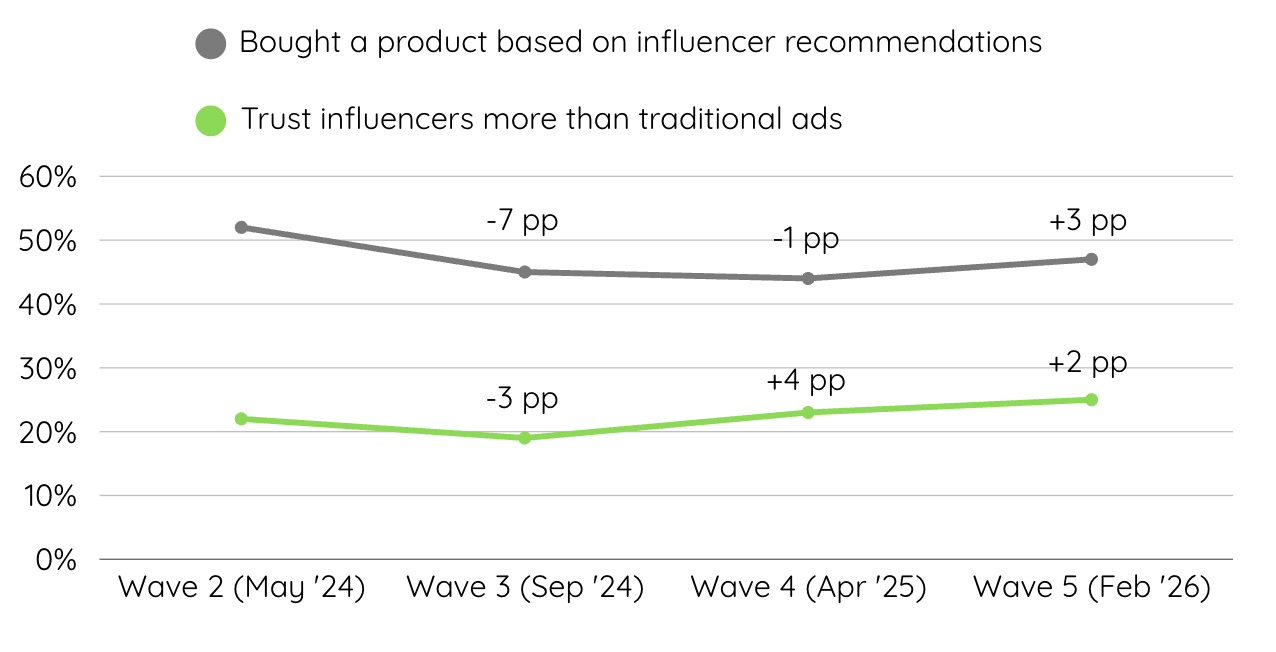
Influencer trust among Gen Z and younger millennials has had a bumpy ride. It dipped in late 2024, recovered in early 2025, and has continued climbing into 2026, and this time, purchases are following.
The two metrics tell a coherent story when read together. Trust bottomed out at 19% in Q3 2024, dragging influencer-driven purchases down with it to 44%. As trust recovered to 23% in Q2 2025 and then 25% in Q1 2026, purchases followed — climbing back to 47%, almost exactly where they stood in Q3 2024. These two lines move together, and that matters: it confirms that trust isn't just a sentiment metric. It's a leading indicator of commercial behaviour.
It's worth being precise about what "trust" means here, though. The 25% who say they trust influencers more than traditional ads is only one part of the picture. A further 33% say they see no difference between influencer recommendations and traditional advertising — a group that has remained stable since Q2 2025. The proportion of active sceptics, those who explicitly do not trust influencers more than ads, dropped 3 percentage points in Q1 2026. In other words: fewer young people are pushing back, and more are at least giving creators the benefit of the doubt.
For brands, the takeaway is pointed: invest in influencer relationships for the long term. Trust builds slowly, dips fast, and when it recovers, the sales data follows.
Influencer Trust and Recommendation-Driven Purchases among 15-30 y.o.
Source: Opeepl Youth Pulse Study, Wave 5 (Q1 2026)
AI Influencers: Curiosity without Conviction
Artificial intelligence has made its way into almost every corner of the digital world — but when it comes to influencer culture, Gen Z and younger millennials aren't buying it. At least not yet.
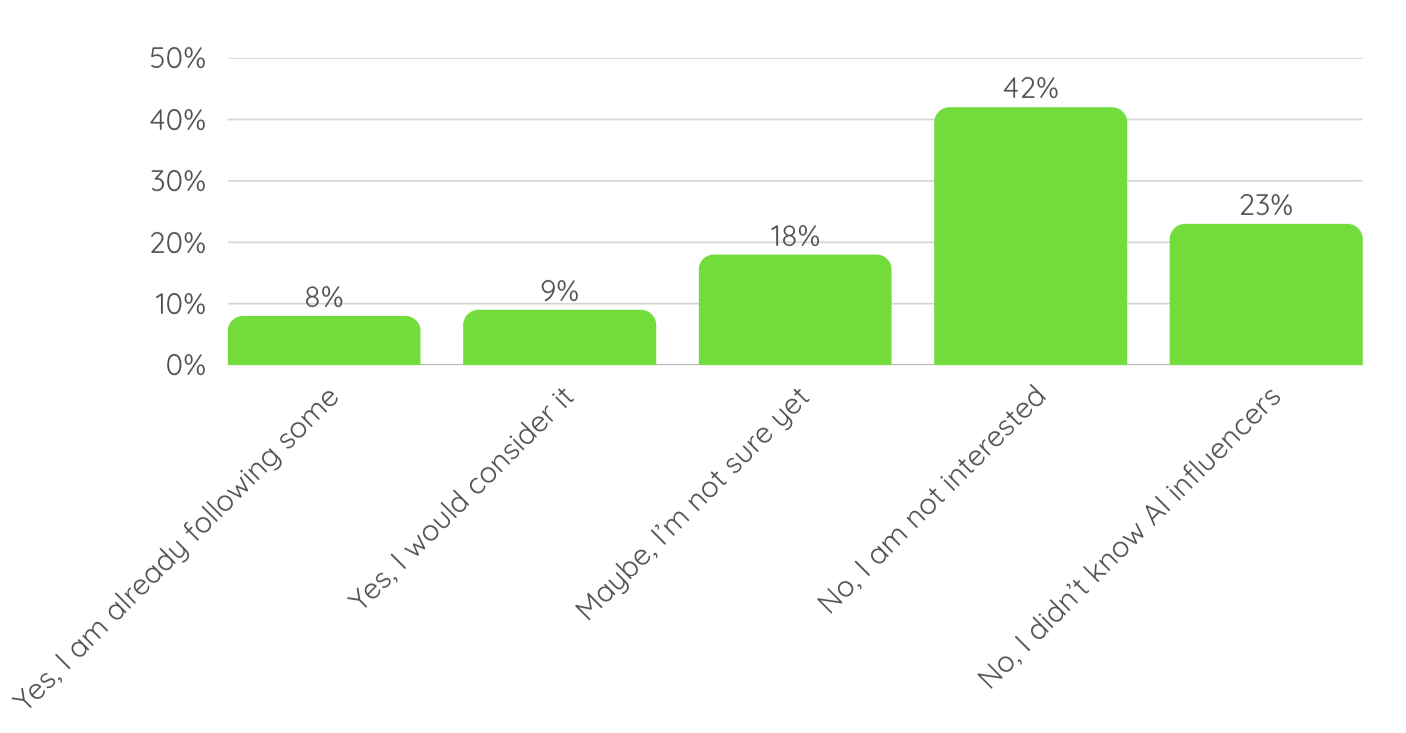
AI influencers are virtual personalities created entirely through artificial intelligence: they post content, build followings, and partner with brands just like human creators do. But according to our study, adoption among 15–30-year-olds remains firmly on the fringes. Only 8% currently follow an AI influencer, and 42% say they have no interest in doing so. Perhaps most telling: 23% had never even heard of AI influencers before being asked about them in the survey.
Q: Would you consider following AI influencers?
Source: Opeepl Youth Pulse Study, Wave 5 (Q1 2026)
The trust picture is equally sobering. When asked whether they would trust information shared by AI influencers, only 5% said yes completely. A further 26% said they would, but only if the content was independently verified or fact-checked, which arguably defeats the purpose of the influencer relationship entirely. On the other side, 56% said no or not at all, and comfort with brands using AI influencers skews heavily negative, with 36% rating themselves a 1 out of 5.
This matters because authenticity is the single most important currency in influencer marketing. Gen Z and younger millennials follow creators because they feel like real people with real opinions, and AI, by definition, cannot offer that. The very thing that makes human influencers effective is what AI influencers currently lack.
That doesn't mean AI influencers have no future. Awareness is still low, and attitudes among younger audiences may shift as the format matures. But for now, brands exploring AI influencer partnerships should do so with caution, and with full transparency about what they are. In a generation that can spot inauthenticity from a mile away, trying to pass off an AI creator as something more is likely to backfire.
For a deeper look at how Gen Z and younger millennials feel about AI more broadly, from daily tool usage to trust in AI-driven decisions, read our dedicated post: Youth Attitudes Towards AI: Usage, Trust, and Fears.
What This Means for Brands
Platform strategy requires precision. TikTok dominates overall influencer engagement at 39% among young consumers, but that headline number masks a significant gender split: 49% of females engage with influencers there versus 30% of males, who instead skew toward YouTube at 27%. Instagram is the only top platform where engagement is close to balanced. A copy-pasted cross-platform campaign will always underperform, the platform shapes the message as much as the creator does.
Entertainment beats promotion - every time. The most-followed influencer category is entertainment, not beauty, lifestyle, or fashion. Young consumers seek out creators who make them laugh or feel something first, with product discovery happening as a secondary outcome. Brands that brief creators to lead with product risk being tuned out before the message lands. The creators who convert are the ones whose audiences forget they're watching an ad.
Trust is a leading indicator of sales, not a soft metric. Opeepl Youth Pulse study data makes this relationship impossible to ignore: when trust dipped in late 2024, purchases followed it down. When trust recovered through 2025 and into 2026, purchases came back up. Brands that treat influencer partnerships as one-off sponsorships are missing the compounding effect that comes from long-term creator relationships, the kind that build genuine credibility over time.
AI influencers are not a shortcut. With 42% of young consumers expressing no interest in following AI influencers, and 56% saying they would not trust the information they share, this is not a channel ready for mainstream brand investment. Authenticity remains the foundation of everything that makes influencer marketing work, and AI-generated personalities have not yet earned it. Brands exploring this space should proceed with transparency and caution, not enthusiasm.
Here's the bottom line: Gen Z and younger millennials aren't just following influencers. They're co-creating their digital experiences with them.
They want real stories, honest reviews, shared values, and creators who act more like trusted friends than walking billboards. Whether you're a brand, a researcher, or a marketer trying to reach this generation, the key hasn't changed — it's just become more urgent.
Stop trying to go viral. Start trying to connect.

Discover more trends among 15-30 y.o. in Youth Pulse Report
Opeepl Youth Pulse is a bi-annual study that keeps pulse on the latest developments in the youth market. Discover key youth trends in consumer confidence, media habits, attitudes, values, and four major categories: Food, Beverages, Fashion, and Personal Care.